Process automation is an investment with measurable results. According to a 2025 Capgemini report, companies achieve an average 1.7x return on investment from AI. Learn how to calculate the ROI of implementing automation and evaluate its profitability for your own processes.
How to calculate the ROI of business process automation?
The primary goal of implementing business process automation is usually to reduce operating costs. Companies want to perform repetitive tasks faster, minimize errors, and make better use of available resources. Therefore, one of the fundamental indicators of automation effectiveness is ROI (Return on Investment).
How much benefit can such an investment bring? This is shown by the results of a 2025 Capgemini study conducted among organizations using artificial intelligence in their operations:
"Our survey of 1,607 organizations shows that the return on investment (ROI) for AI in operations is, on average, an impressive 1.7x." Capgemini report "AI in action: How gen AI and agentic AI redefine business operations", 2025
What does a 1.7x return mean in practice? According to Capgemini data, the surveyed companies invested a total of $343 million in AI solutions, achieving $575 million in operational savings. This means that for every dollar invested, there was approximately $1.70 in savings. To calculate ROI as a percentage, subtract the invested funds from the benefits obtained, divide the result by those costs, and multiply by 100%. Below is the most basic formula for ROI:
In the case of the Capgemini study, this results in an ROI of approximately 68%.
In addition to percentage ROI, you can also calculate the Payback Period, which is the time required to recover the costs incurred. Simply divide the cost of implementing automation by the monthly net savings. For example, if an implementation costs EUR 30,000 and generates EUR 5,000 in monthly savings, the investment will pay for itself in 6 months. This indicator allows a company to more easily assess how quickly automation will start to yield financial benefits.
Calculating the payback period and ROI of automation – how to calculate savings?
The simplest way to calculate the ROI of automation is to determine how much time employees save by streamlining a given process. Simply multiply the number of hours saved by the employee's hourly labor cost. For example, if automation saves 100 hours per month and the cost of one hour of work is EUR 30, the company gains the equivalent of EUR 3 000 per month. These calculated savings can then be used to determine ROI and the Payback Period.
However, it is worth remembering that implementing automation systems brings benefits that go beyond just saving labor time. Investing in automation can also mean:
Reduction of manual errors – properly designed automation limits mistakes resulting from manual data entry and processing.
Lower supervision expenses – reducing manual work allows for a decrease in the time required to check the accuracy of completed tasks.
Faster processes – faster task completion can increase a company's capacity, and in sales and marketing processes, it can also translate into increased revenue.
At Sagiton, when presenting the Payback Period in months in our case studies, we primarily base our calculations on real client data regarding time saved. This ensures our figures are grounded in concrete, measurable benefits rather than hard-to-verify assumptions. In practice, automating processes can yield even greater benefits for a company than those we include in our basic ROI calculation. It is worth keeping this in mind when analyzing the automation examples presented later in this article.
ROI examples from Sagiton automation implementations
Although the ROI of automation varies depending on which processes are automated and how, many companies want to know the potential return as early as the implementation discussion stage. To show what results can be expected, we present sample ROIs from process automation projects at our clients' companies.
1. B2B sales process automation
As part of this project, we automated repetitive tasks related to B2B sales support, reducing the need for manual data processing. The solution streamlined data flow and relieved sales representatives of administrative tasks, allowing them to dedicate more time to client interaction and sales growth.
Over 12 months, the company saves approximately EUR 16 000, achieving EUR 8 000 in net benefits and an ROI of 100%.
2. Marketing and sales dashboard
We created a dashboard that automatically collects and presents key marketing and sales data. Instead of manually preparing reports, employees can monitor performance in real-time, analyze the effectiveness of their activities, and make faster decisions based on up-to-date information.
Over 12 months, the company saves approximately EUR 21 400, achieving EUR 10 700 in net benefits and an ROI of 100%.
3. Competitor price analysis automation
We automated competitor price monitoring, eliminating a significant portion of manual data collection and comparison. The solution enables faster analysis of the market situation and helps in making more accurate decisions regarding the company's pricing policy.
Over 12 months, the company saves approximately EUR 4 800, achieving EUR 3 600 in net benefits and an ROI of 300%.
4. Onboarding automation
The implementation streamlined the process of introducing new employees to the organization by automating repetitive administrative and organizational tasks. As a result, HR and IT teams spend less time coordinating onboarding, and the entire process runs more smoothly and according to a set schedule.
Over 12 months, the company saves approximately EUR 30 600, achieving EUR 20 400 in net benefits and an ROI of 200%.
5. AI agent implementation for customer service – Anda Śruby
For the Anda Śruby wholesaler, we created a system that automates the handling of B2B quote requests. The AI agent analyzes messages and attachments, identifies products, and prepares line items for quotes. Thanks to integration with Subiekt and Airtable, sales staff can prepare offers more efficiently instead of manually processing customer inquiries.
Over 12 months, the company saves approximately EUR 74 300, achieving EUR 6 200 in net benefits and an ROI of 9.1%.
Although the estimated ROI for this project in the first year is 9.1%, it is worth viewing it in a broader context. Automation allows for the recovery of work time valued at over EUR 74 300 annually, and after the first 12 months of the solution's operation, the benefits exceed the implementation cost by approximately EUR 6 200.
Furthermore, our basic calculation only accounts for the value of saved work hours. It does not include other benefits, most notably the significant acceleration of the sales process. By preparing quotes faster, sales representatives can respond to clients ahead of the competition, increasing the chances of winning orders. In practice, this can lead to a substantial increase in sales that we have not included in the calculation.
Automate your business processes with us – fill out the form, and we will contact you to schedule a meeting with one of our consultants.
Although as an agency specializing in AI and automation implementations we help companies streamline their business processes, we know that not every implementation is economically justified. It happens that during the very first conversation with a client, we realize that the cost of implementation will be disproportionate to the potential savings. In such situations, we are transparent about it and work together to find a more cost-effective solution – sometimes it is enough to modify the scope of automation, and sometimes it is better to shift the budget from one process to another.
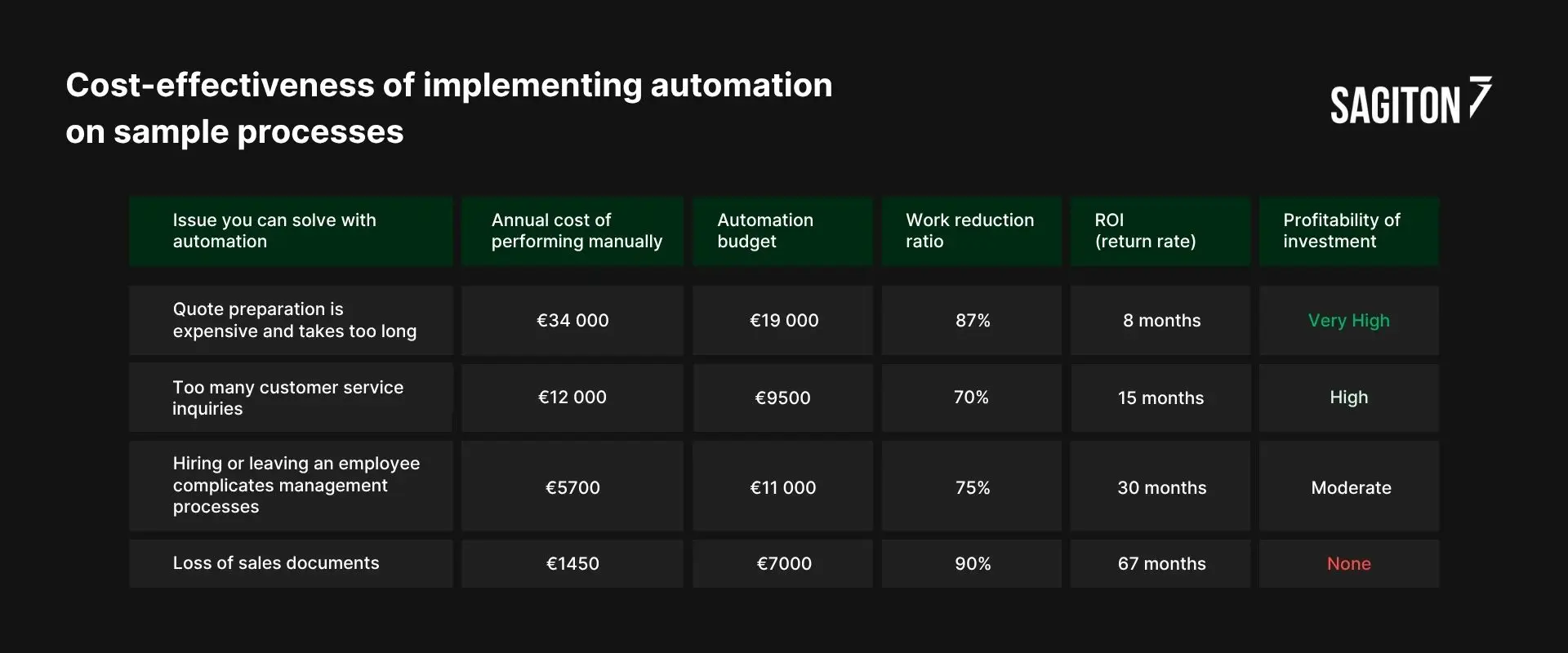
So, when is implementing automation not worth it? At Sagiton, we consider automation that pays for itself within 12 months to be a very profitable investment. The longer the payback period, the more cautiously one should approach such a project. If the implementation and maintenance of automation are only expected to pay off after more than 3 years, it often turns out that the investment lacks economic justification. However, the final assessment also depends on other benefits, such as reducing errors, increasing operational capacity, or improving customer service quality. The table below presents example processes and shows how the payback period affects the profitability of automation.
Do you want to see how automation can improve your company's operations? Contact us! The Sagiton team will provide a free assessment of whether your process is suitable for automation, analyze opportunities for improvement, and help you estimate the profitability of the implementation.
Join our newsletter
Subscribe and receive additional content, checklists and business automation tips from us.
Thank you for subscribing to our newsletter!
You will soon receive a welcome message at the email address you provided.
Oops! Something went wrong, failed to send the form.
Book a free consultation with our process expert
Fill out the contact form, and one of our specialists will schedule a free, 30-minute online consultation to help you determine which automation solutions would be most profitable for your business.
Implementing AI in Business – How to Choose the Right Solutions? Practical Case Studies
AI-powered process automation enables companies to complete tasks more quickly and reduce daily operational costs. Learn what to consider to achieve your intended results.
Read more
Business automation
07.07.2026
organising-tools-and-data-in-the-companies
Too many business tools? See How Automation Organizes Data
An overabundance of SaaS tools often leads to data dispersion, increased costs, and decreased operational efficiency. In the article, we explain how to organize the flow of information and build a scalable work environment through the automation of business processes.
Read more
Business automation
07.07.2026
office-automation
Office automation — how to increase work efficiency?
Read the article and find out what office activities are worth automating in order to realistically affect the quality and speed of work at your enterprise.
Read more
Contact us!
Select the topic you are interested in in the form and our specialist will contact you within 24 working hours.
Thank you for contacting us!
Your message has been successfully sent. We will reply as soon as possible.
Oops! Something went wrong, failed to send the form.