AI-powered process automation enables companies to complete tasks more quickly and reduce daily operational costs. Learn what to consider to achieve your intended results.
What we expect from AI implementation in an organization
During the AI "boom," many companies tested several tools using this technology simultaneously, which led to organizational chaos and made it impossible to draw any meaningful conclusions. Now, in 2026, when each of us has already encountered artificial intelligence in both professional and private life, we can approach AI implementation a bit more calmly. We already know, at least in most cases, how such systems work and what results we can expect.
And in reality, we don't need another set of "8 AI tools everyone must know" – as businesses, we primarily need solutions that will help us:
Reduce operational costs – this is probably the first aspect most companies consider – running businesses is becoming more expensive, so naturally, we look for ways to save money. AI can be one of them, though not always, but we'll discuss this further in the article.
Accelerate internal processes – because how long can one wait for the finance department to prepare that report or HR to summarize the last quarter? As entrepreneurs, we demand the ability to make data-driven decisions here and now, not in a month, and AI solutions can genuinely help us with this.
Increase company profitability – higher sales without constantly increasing the marketing budget and hiring more specialists? Thanks to automation and AI systems, this is possible, though certainly not yet simple.
And with all this, the implementation of artificial intelligence in our processes must, of course, also ensure data security and the security of existing IT systems.
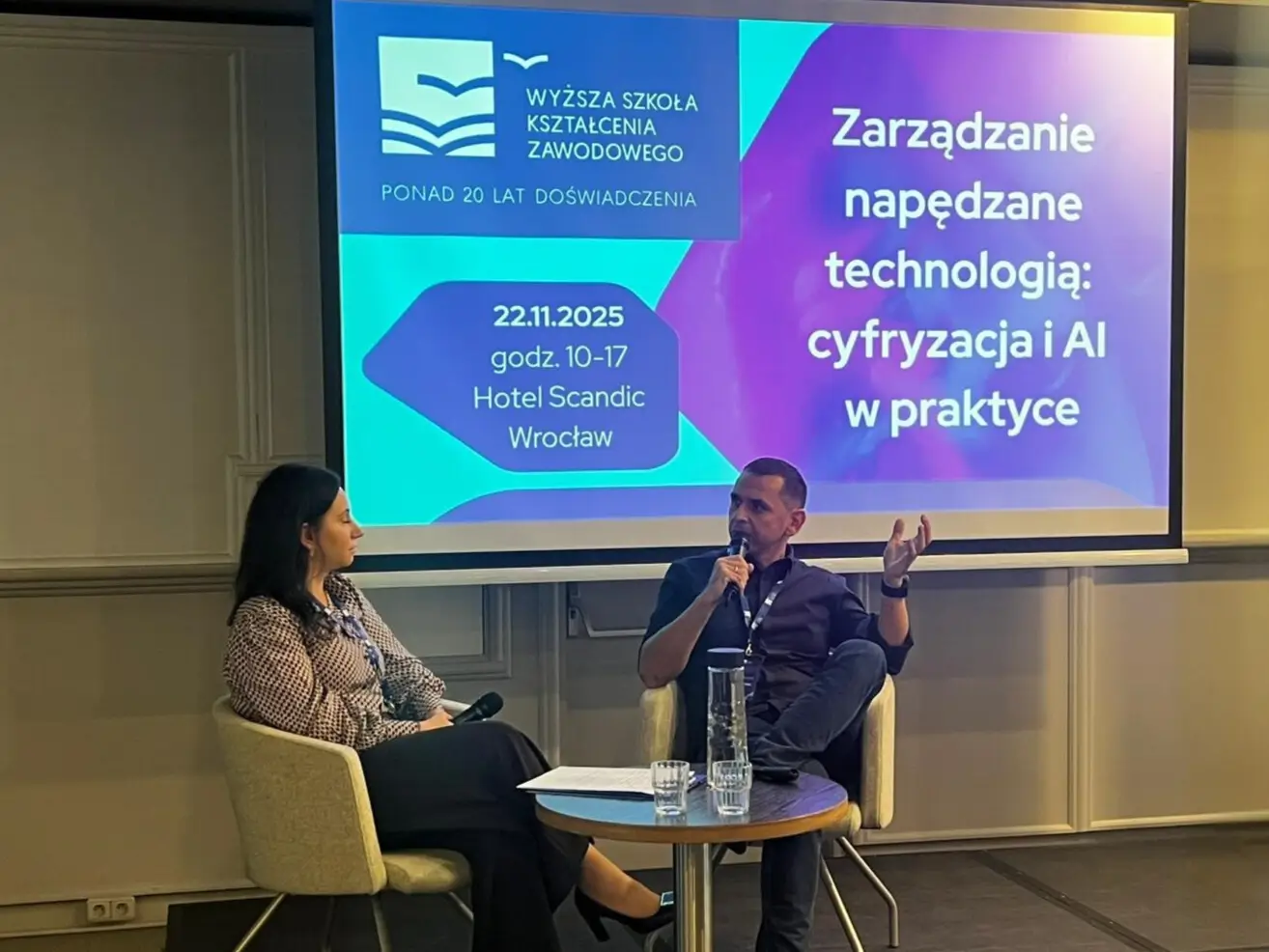
CEO of Sagiton Automation – Marcin Michalski – at the WSKZ conference Digitalization and AI in practice, November 2025
We will discuss how to profitably implement AI technology into company processes in the next paragraph.
How to implement AI in a company to achieve the best business benefits
If we assume that our business goal is to learn about as many AI tools as possible, to understand how, for example, programs for generating graphics or data visualizations work, then it is certainly worthwhile to purchase as many subscriptions as possible, hand the tools over to employees, and ask them in a few weeks how they are working with AI.
However, if you want to use AI in your company to achieve the goals we mentioned in the previous paragraph, such as increasing profitability or performing tasks faster – this is not the way.
You must then approach an AI implementation project like any other process or internal regulation change. First, you need to identify the problem you want to solve using AI. And no, high operational costs are not your problem – the problem is what generates them and all the obstacles that stand in the way of scaling your sales.
Next, you need to analyze which technological solutions will be optimal for your business. AI is not a magic cure-all; sometimes a simple automation workflow or just changing your invoicing software will work better.
Example: If you are a company that sells consulting services and invoicing involves calculating the rate by the number of specialist hours – then you probably don't need to implement AI for that. Simple automation, which would be cheaper and faster to implement, could help you.
Only when you know what problems you need to solve to achieve your goals can you truly start developing a strategy. Sounds like a lot of work? Sometimes it is. Everything depends on the complexity of your processes and the number of business tools your company currently uses. As Sagiton Automation, we are one of the companies that offer comprehensive AI implementation for businesses in Poland – from process analysis and recommendations to the deployment of AI automation.
In the following practical paragraphs, we will discuss our case studies of so-called AI automation, which are automation systems partly based on artificial intelligence.
Case Study: Automating the Quoting Process with an AI System
One of the projects that clearly demonstrates how to implement AI in a company step-by-step was the creation of an AI agent supporting the quoting process for a client in the metal component sales industry.
When the client approached us, they were already technologically aware. They knew that an AI model could help them increase the number of inquiries handled for quotes, speed up the sales department's work, and reduce the need to hire additional staff. However, they were unsure which elements of the process were truly worth automating, where AI would bring real value, and where it might even worsen the customer experience. That's why they reached out to us.
And this is a very important point we mentioned earlier – effective AI implementation doesn't start with choosing a tool. It begins with understanding how the company truly operates and what will best help us with our specific problem.
In the inquiry sent to us by the client company's manager, it was described that the main problem was a large number of quoting inquiries reaching a small sales team. Each request required a phone call with the client, gathering technical details, checking collaboration history, analyzing data from sales systems, and preparing an individual offer. Salespeople spent a lot of time not only on direct client contact but also on manual notes, information retrieval, and creating preliminary estimates. The company had sales potential, but business processes couldn't keep up with the volume of inquiries. Some sales opportunities were handled with delays, and some were simply lost.
From Process Analysis and Audit to Decision
We began our work by auditing business processes and thoroughly mapping the quoting path – from the moment an inquiry was received, through the sales conversation, all the way to preparing and sending the offer. We checked how salespeople worked, what tools they used, which tasks they performed manually, and where delays most frequently occurred.
Such a process analysis allowed us to separate tasks that could genuinely be supported by AI from those that should still remain human-driven.
For example, initially, using a voicebot for phone calls might have seemed like a natural idea. However, after analysis, we decided with the client that this wouldn't be a good solution in this case. The company operates in a specialized B2B segment, and sales conversations involve technical products, often requiring a salesperson's expertise. Additionally, this company's clients value direct human contact, so replacing conversations with a voicebot could lower service quality and negatively impact sales.
Instead, we designed the software in a way that AI works "in the background" – within the organization, without changing how clients are contacted. The end client still speaks with a salesperson, but on the company's side, the AI agent takes over most of the analytical and preparatory work.
How does the implemented solution work?
The agent we created combines several elements of automation and AI. After a sales conversation, the artificial intelligence model uses VoIP integration to record the call, then passes it to a transcription tool. Based on this, the AI agent prepares a summary of the conversation and extracts the most important information needed to create an offer.
Next, the system analyzes data from several sources, including Subiekt, HubSpot, and past purchase history. This means the salesperson doesn't have to manually check if the client has previously bought similar products, what their terms of cooperation were, what their purchasing potential is, and what information should be included in the offer.
Based on this, the AI agent prepares a draft offer, which goes to the sales department for review and approval. Importantly – the AI does not send the offer independently. In this model, the system speeds up the process, but the final decision is still made by a human (the so-called human in the loop).
Additionally, we implemented internal AI chatbots that serve as a test control module. The client can independently check if generated offers are correct, ask questions about the system's operation, and verify its responses without needing to contact technical support every time. This additional layer of security in the form of an AI chatbot allows for quicker detection of potential errors and gives the team greater control over the solution's operation.
Implementation Results
The entire project was completed within6 weeks, and the implementation cost was EUR 10 500. Thanks to automation, the client currently saves approximately 60–80 working hours per month, which allowed us to calculate a return on investment of about 5 months.
Most importantly, however, the implementation directly contributed to two business goals we mentioned at the beginning of the article:
Firstly, the client significantly accelerated internal processes. Thanks to working with AI,Sales representatives can prepare offers faster, handle more inquiries, and spend less time on administrative tasks.
Secondly, the company increased its sales potential without needing to expand its team by another 3–4 people. This has a real impact on improving the company's profitability – sales can grow, but the operating costs of the sales department do not increase at the same rate.
This AI implementation in the company clearly shows that the use of this technology doesn't always have to be visible to the end customer. Sometimes, AI delivers the best results when it operates in the background: organizing data, analyzing conversations, preparing document drafts, and relieving employees of repetitive tasks. This allows humans to continue focusing on client relationships, while having a system that enables them to work faster, more accurately, and handle a larger number of inquiries simultaneously.
Looking to implement AI into your company's processes? Contact us to schedule a free online consultation with our specialist!
A second example demonstrating the effective use of AI in a company is a project carried out for a client in the B2B services sector, whose sales department was struggling with a large number of leads and overly time-consuming handling of each inquiry.
The problem the company approached us with
The problem was not a lack of interest in the offer. On the contrary – many potential clients were contacting the company. The bottleneck, however, was the post-initial contact service process. Each online meeting typically lasted about an hour, but after it concluded, the salesperson still had to manually prepare a summary, write a follow-up message, update the CRM, create tasks, and begin preparing the offer.
In practice, this meant that a single lead, who had not yet decided on further cooperation, required even 3 hours of additional work. With a larger number of inquiries, salespeople were therefore unable to quickly close deals, and some potential clients waited too long for a specific response.
Similar to the previous case study, we didn't start our collaboration with the client by asking: "Which AI tool would you like to use?". First, we examined the sales-side business processes and identified which activities could truly be accelerated without compromising the quality of relationships with clients. In this case, we deliberately did not replace the online meeting with a salesperson. In B2B services, a conversation with an advisor remains one of the most crucial elements of the sales process. Smart AI implementation in a company is not about removing humans from every stageof contact, but about relieving them where their time is not best utilized.
Therefore, we designed a solution where the system primarily operates after the meeting – it organizes information, prepares materials, and updates the sales backend.
AI Solutions Proposed to the Client
As part of the project, we implemented:
Automatic transcriptions of online meetings and phone calls – the system records discussion points, extracts the client's key needs, and prepares a structured summary.
Generating a PDF summary for the client – after the meeting, the salesperson can quickly send the lead a professional summary of the agreements, which reduces the number of additional questions and improves the first impression.
Automated tasks in CRM – the solution analyzes the conversation and creates tasks, for example, sending an offer, contacting at a specific time, or preparing additional materials.
AI-powered lead scoring – the system evaluates the lead's sales potential based on conversation data, the history of similar clients, and criteria defined by the company.
Support in offer preparation – the salesperson receives a preliminary message draft and an offer structure tailored to the meeting's agreements.
Automated follow-ups – the system suggests or prepares messages for clients who requested contact at a specific time or did not respond after receiving an offer.
The goal was not to replace the sales department, but to streamline its daily work. The salesperson still conducts conversations, builds relationships, and is responsible for sales decisions, but no longer has to perform all administrative work from scratch after each meeting. As a result, handling a single lead was cut by up to half. Instead of an hour-long meeting and several more hours of manually entering information, preparing summaries, and organizing the CRM, the team can complete basic lead handling in about 1.5 hour – 1 hour of conversation and about 30 minutes of post-meeting work.
In practice, this means that salespeople can handle up to twice as many inquiries without increasing the team. Importantly, this does not come at the expense of quality. Clients receive summaries faster, offers are prepared more efficiently, and follow-ups no longer depend solely on the salesperson's memory. This is a good example ofusing artificial intelligenceand AI for automation not to replace sales, but to remove repetitive tasks that slow down closing deals.
Pitfalls to watch out for when implementing AI in business
As you may have already gathered from this article, applying AI in a company only makes sense when we know what purpose we are using it for. Implementing AI just for the sake of having this technology in your business processes makes no sense.
However, there are a few additional aspects that we should keep in mind:
1. Implementing AI in a way that could harm the company's image
Not every use of AI needs to be visible to the end customer. Sometimes, it's better to "hide" the technology within internal processes, as was the case when we implemented AI tools to support sales representatives for our clients.
Several companies have already made the mistake of replacing people too quickly with AI solutions in areas where customers expected human interaction, authenticity, or a personalized approach. Unfortunately, instead of optimization, this led to a deterioration of the customer experience and a risk of losing trust.
Interestingly, in marketing, we're even seeing an opposite trend today. Because the volume of AI-generated content is enormous, authentic materials showing real people, genuine products, and behind-the-scenes company work are increasingly well-received. That's why brands are more often recording short "making-of" videos to demonstrate that their content is genuinely created with team involvement, not solely by AI.
2. Failure to measure AI effectiveness across the company
Implementing AI in your company isn't the end of the work. On the contrary, that's when the phase of verifying whether the technology actually delivers the expected results truly begins.
It's important to remember that simply providing a tool to employees doesn't automatically mean successful AI implementation or that the company will suddenly operate faster. Some team members might feel threatened by the new technology, not use it regularly, or only use it superficially. It can also happen that AI does save time, but the freed-up hours aren't allocated to other tasks, so processes continue at a similar pace.
Therefore, effectiveness must be measured. And ideally, this should be based on concrete data, not just a general impression that "work is faster":
If you're implementing AI for lead management, check how many leads a salesperson handles weekly with AI assistance compared to how many they handled before using the solution.
If you're automating report generation, compare the time needed to create them before and after implementation.
If AI supports customer service, analyze response times, the number of resolved tickets, or customer satisfaction levels.
Only then can you truly assess whether AI's potential is being properly utilized or if the project requires changes.
A separate article could be written about the security of AI systems – and in fact, we've done just that. However, the most important thing is that AI should not be implemented without technical oversight, especially if it has access to customer data, sales applications, CRM, company documents, or internal communications.
The problem is that non-technical individuals often undertake AI implementation within a company. While there's nothing wrong with this during the idea testing or improvement-seeking phase, if the solution starts operating on real company data, it must be thoroughly checked for security.
The negative consequences of a poorly designed system often only become apparent after something has already happened: data leaks, an AI agent gains access to information it shouldn't see, or an automation performs an action nobody anticipated. Therefore, before releasing a solution into "production," it's crucial to check, among other things, what data goes into the model, who has access to it, what permissions the AI agent has, whether the system logs action history, and if there's a way to quickly stop the automation in case of an error.
In summary, what you need to know about implementing artificial intelligence in your company
Implementing artificial intelligence in a company only makes sense when it addresses a real business problem, not just the desire to 'have AI.' It's crucial to first analyze processes, identify areas where costs or delays occur, and only then choose the right solutions – which might be an AI agent or simply automation. The most successful companies are those that measure implementation results, prioritize data security, and deploy AI where it truly supports employees and boosts profitability.
If you need help with such an analysis, as a company specializing in AI strategy for businesses, we provide so-called AI consulting – we help companies select AI tools and usage methods to ensure projects are truly profitable and deliver measurable results.
Join our newsletter
Subscribe and receive additional content, checklists and business automation tips from us.
Thank you for subscribing to our newsletter!
You will soon receive a welcome message at the email address you provided.
Oops! Something went wrong, failed to send the form.
Interested in implementing AI in your company?
Contact us to schedule a free consultation with our specialist, who will help you identify areas in your business that can be optimized with AI.
AI Transcriptions for Sales – Speed Up Sales Processes with AI
The times when salespeople had to manually record arrangements with the customer are gone irretrievably. Stacks of notes, understatements or lost emails are a thing of the past. Read our article to learn how automated call transcription can speed up your sales processes and help you turn your data into a competitive advantage.
AI in e commerce — new online store automations that pay off
In this article, we present practical applications of AI in e-commerce that allow you to save time and optimize operational activities. Read and learn how modern AI tools support process automation in online sales.
Read more
Cybersecurity
07.07.2026
automation-processes-and-data-security
Cybersecurity in Business Process Automation: How to Protect Data and Stay in Control
Automation systems are becoming an integral part of business processes in many companies. Read the article and learn what to look out for and how to ensure data security in your organization when implementing business process automation.
Read more
Contact us!
Select the topic you are interested in in the form and our specialist will contact you within 24 working hours.
Thank you for contacting us!
Your message has been successfully sent. We will reply as soon as possible.
Oops! Something went wrong, failed to send the form.



.webp)

.webp)