Automation in manufacturing doesn't necessarily mean just buying expensive machinery or fully robotizing your facility. Often, the biggest savings start with streamlining the flow of information, orders, and data between departments. Read the article and find out what solutions will help you increase production profitability.
Rising costs for staffing, electricity, materials, and logistics are causing many manufacturing companies – especially small and medium-sized ones – to increasingly feel the pinch of declining sales profitability. Even if the number of orders remains stable, margins can decrease due to manual, time-consuming processes, communication errors, downtimes, and suboptimal work planning. Fortunately, manufacturing process automation enables businesses to speed up operations, reduce ancillary production costs, and better utilize available resources. Below, we present 6 improvements that can help increase production profitability.
1. Automation for Machine Operation Monitoring
In many manufacturing companies, information about how much individual machines work, their utilization, and their performance is either not collected at all or recorded on paper. And while this may not seem like a big problem at first glance, it can lead to serious consequences, including delayed reactions to deviations in performance, energy consumption, or actual equipment utilization.
Fortunately, the digitalization of data collection processes can help businesses. Thanks to modern technologies, industrial companies integrate their production equipment with data visualization applications. This creates administrative dashboards that allow real-time checking of how much energy a given machine consumes, how long it operates, whether it's functioning correctly, and when the last breakdown or downtime occurred.
In such systems, key data from the production line is recorded historically, allowing for comparison of machine performance, power consumption, and utilization levels with previous days, weeks, or months. Based on energy consumption, operating time, and other parameters, the system can determine whether the equipment is operating correctly, is in standby mode, or requires intervention. If the planned machine utilization was 86% and the actual is 67%, this could mean that the order is being completed faster than anticipated, which should be considered in future quotes. Conversely, utilization at 95% might indicate an underestimation of time, costs, or machine availability. When irregularities occur, relevant personnel receive notifications, and the system can automatically suggest reporting the machine to the service department or an external service provider.
In addition to monitoring power consumption, other parameters relevant to specific machine types can also be measured. Examples include temperature control logs in refrigeration units, necessary during health department inspections, monitoring the number of units produced on a production line, or controlling the operating time of equipment responsible for key production stages.
2. Document Workflow Systems in Manufacturing Companies
Document management programs in a manufacturing company can cover many different processes – from sales contracts and production orders to warehouse documents. If you want to streamline one of these areas, it's worth starting with an in-depth analysis – when, where, and most importantly, why documentation is created in your company. Then, you can focus on what process improvements you can implement to minimize manual work. Below, you'll find our suggestions for this type of automation in a manufacturing plant for 3 different areas:
Sales Contract Management
In manufacturing companies, automation can streamline the handling of customer contracts, offers, and invoices requiring internal approval. An example document workflow in a manufacturing company for the sales department might look like this:
an employee selects the contract type,
the system retrieves customer data from the CRM and populates the contract or order template with it,
the system forwards the contract for manager approval,
the contract is automatically sent for electronic signature.
Once signed, the file can be saved in the appropriate folder, named according to a defined scheme, and assigned to the client or order.
Production Order Management Systems
Automation is also effective in production order management systems because it integrates communication between the client, sales, and production into a single process. Upon receiving an inquiry, the system can create a sales opportunity, assign it to a salesperson, gather data needed for quoting, account for margins, material costs, and production capacities, and after offer acceptance, transfer the complete information for execution.
Warehouse Document Flow in a Manufacturing Company
Similarly, the flow of warehouse documents in a manufacturing company can be streamlined. The system can automatically record the stocking of materials used in order fulfillment and then reserve appropriate quantities for specific orders. This is especially important when a single order requires multiple different materials. Automation can also include post-fulfillment logistics – for example, preparing a checklist of required files, collecting confirmations, ordering transport, and relaying necessary information for the delivery of finished products to the client. As a result, the process is faster, material stock levels are more up-to-date, and the team has better control over what is in the warehouse and what has already been allocated to specific orders.
Contact us and take a step towards digitizing your business processes!
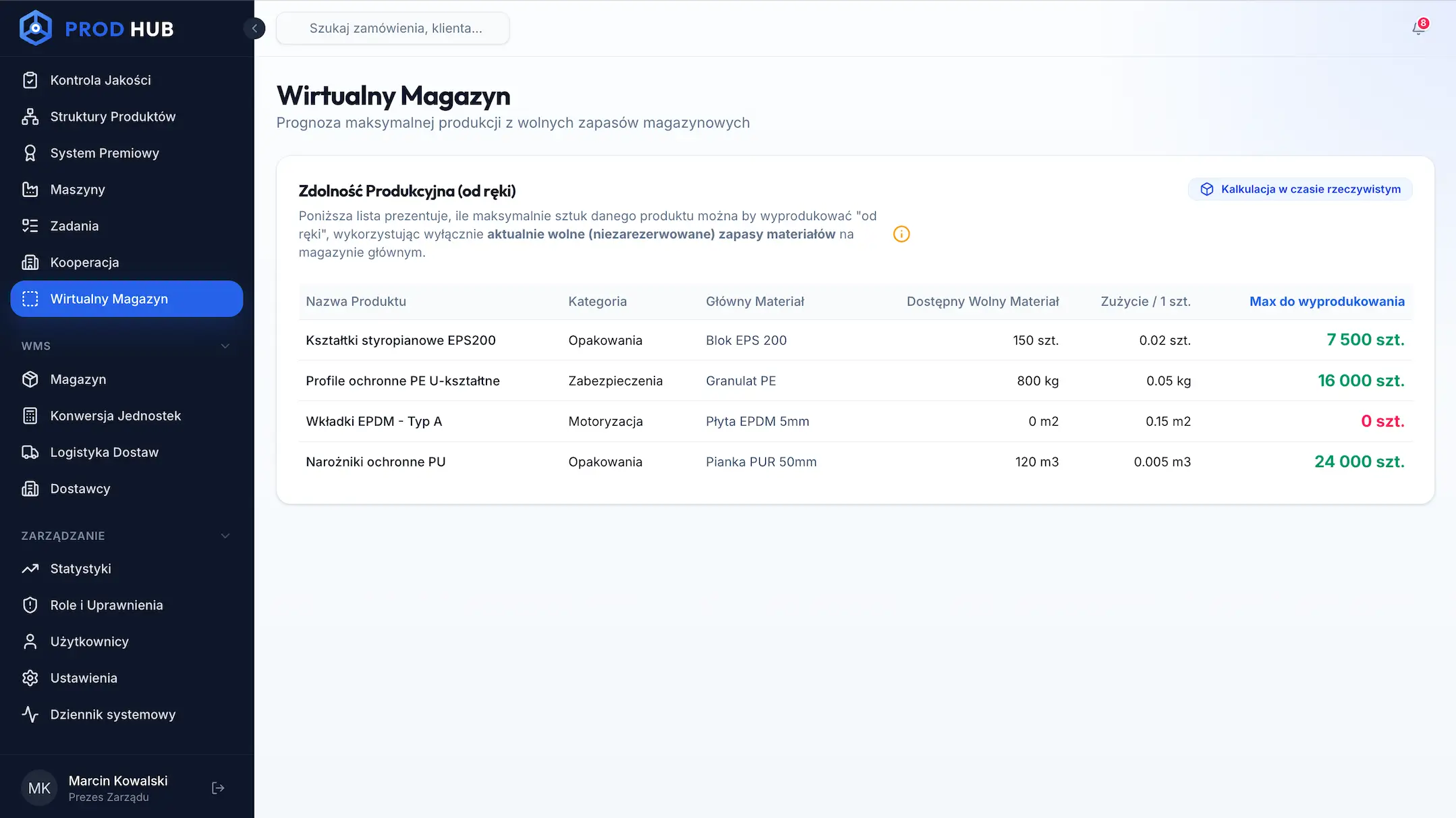
Automation of production processes can support not only the current fulfillment of orders but also the planning of what a company can quickly produce from available materials. Based on current inventory, recipes, raw material consumption norms, and available production capacities, properly programmed automation can calculate stock levels in a "virtual warehouse."
In practice, this means that a salesperson or production manager can see how many units of a given product can be produced "on demand" without ordering additional materials. If a client inquires about availability, the company can more quickly prepare an offer, confirm a realistic delivery date, and avoid promising production that cannot be completed on time.
A demo of a virtual warehouse that shows the maximum number of units that can be produced
Such automated inventory coordination directly impacts a company's profitability. It helps better utilize dormant materials, reduce excessive raw material purchases, and minimize the risk of downtime due to material shortages. As a result, the company can fulfill more orders with existing stock, improve financial liquidity, and increase profit margins without raising production costs.
4. Automated Statistics for Production Control
Thanks to integrations between various systems, we can create clear dashboards with different types of data. Such reports help quickly assess whether a process is proceeding according to plan and where deviations occur. In industry, the most frequently monitored operational indicators are:
monthly plan fulfillment,
machine efficiency,
material consumption deviation,
exceeding material norms,
employee productivity,
material shortages and their causes.
Visualization of sample KPIs for a manufacturing company
Digitizing these types of reports allows us to react more quickly to errors or deviations – even before they lead to significant financial losses.
5. Automated Notifications for the Team
Automation can also include notifications for those responsible for maintaining the continuity of production processes. This allows the team to react more quickly to events that could lead to downtime, material losses, or quality issues. Faster reaction means a lower risk of costly breakdowns, complaints, and delays, thus providing real support in improving the company's profitability.
Properly implemented production automation can send notifications about, among other things:
exceeding machine operating norms or the need for technical support,
changes in room conditions – for example, where a cold storage unit operates,
deviations in parameters such as temperature, humidity, or power consumption,
sudden data loss, e.g., when a recorder stops taking measurements,
the need to perform a review after the installation is complete,
different errors in the reporting process.
Such alerts facilitate the ongoing optimization of plant operations and help reduce losses before a problem impacts order fulfillment.
6. CRM Tools for Manufacturing Companies
Typical CRM systems for sales management are often not adapted to the specifics of production processes. They work well for managing contacts, sales funnels, or communication history, but they typically do not account for process elements such as quoting based on client designs (e.g., nesting planning), production capacity availability, order fulfillment status, or links to production documentation.
Thanks to the latest technologies, creating your own dedicated CRM is increasingly a better, cheaper, and faster solution. Such an application can then be tailored to the company's actual way of working and implement automations that genuinely support sales and production – including connecting the CRM with production orders, as we mentioned at the beginning of the article.
As a result, the company does not have to adapt its processes to a ready-made tool. Instead, the system supports the company's specific operating model, helps reduce manual information transfer between departments, and facilitates control over order profitability. We discussed other benefits of replacing typical CRM tools with dedicated solutions in the article: https://www.sagiton.pl/blog/alternatywy-dla-systemu-crm
Why is implementing production process automation profitable?
Automation of production processes allows companies to complete tasks faster, reduce errors, and better utilize available resources. As a result, investing in such solutions can lead not only to more efficient team work but also to higher profitability for the entire enterprise. With automation, you will achieve:
Faster Production – automation shortens the time required for repetitive tasks, allowing the company to handle more orders and increase production capacity without a proportional increase in costs.
Better Management Decisions – managers gain access to up-to-date data on machine operation, downtimes, or production load, which facilitates planning and faster response to problems.
Higher Sales and Margins – salespeople can prepare more accurate quotes faster, and solutions like virtual inventory streamline inquiry handling and help better control product availability.
If you are looking for a company from Wrocław that can help you with process automation in a manufacturing enterprise, contact us.
Join our newsletter
Subscribe and receive additional content, checklists and business automation tips from us.
Thank you for subscribing to our newsletter!
You will soon receive a welcome message at the email address you provided.
Oops! Something went wrong, failed to send the form.
Contact us and schedule a free consultation with our specialist
Unsure which area of your business to automate? Contact us! Sagiton is a comprehensive technology partner for implementing automation and AI. We'll guide you through the entire digitalization process – from analysis to the implementation of effective solutions.
6 Ways to Use Artificial Intelligence in Your Business
Find out in which areas of business the use of artificial intelligence is most cost-effective and what the biggest benefits of AI are for businesses.
Read more
Business automation
06.07.2026
automation-of-document-flow
Automation of electronic document flow in the company
Long contract processing, constant delays in signing orders or communication chaos in the administration department? Read our article and learn how implementing document flow automation in your company can improve your business processes!
Read more
Sales
06.07.2026
bid-management-automation-speed-up-your-offers
Bid Management Automation — how to speed up Offer Creation with AI
The process of creating offers is an integral part of acquiring clients in many industries, especially in the B2B sector. Read our article and learn how to speed up the sales process and respond to more inquiries at the same time, thanks to the automation of the creation of trade offers.
Read more
Contact us!
Select the topic you are interested in in the form and our specialist will contact you within 24 working hours.
Thank you for contacting us!
Your message has been successfully sent. We will reply as soon as possible.
Oops! Something went wrong, failed to send the form.




.webp)
.webp)


