The problem that the manufacturing company came to us with
A company with one production facility came to us, which was concerned that it was not a large enough to make automation of production management profitable for it. The client wanted to implement a system that primarily streamlines the bidding process, because the calculations were carried out in Excel (e.g. planning the working time of machines and material consumption), and the nesting process in various graphic and CAD programs. The solution was to calculate:
the amount of material needed,
production time of one piece,
material requirement for specified MOQ (Minimum Order Quantity).
During analysis of internal processes however, it turned out that the optimization potential is much greater. Even relatively simple production management software could significantly improve the functioning of the company.
As a result, together with the client, we decided to create a dedicated solution covering the entire process — from the first contact with the customer, through calculation and planning, to production and shipping.
The functionalities of the production management system proposed by us
As we wrote in the previous paragraph, the prepared system was not limited only to the automation of nesting. It has been expanded with a number of modules supporting comprehensive sales and production management.
Importantly, the client had previously analyzed the software available on the market for production, but none of them fully met his requirements. In addition, the subscription model of many systems meant that their annual cost could exceed the investment in simple, dedicated software.
In the next sections of the article, we will discuss the individual modules of the production management system that we proposed to our client.
Request for Quotation Management
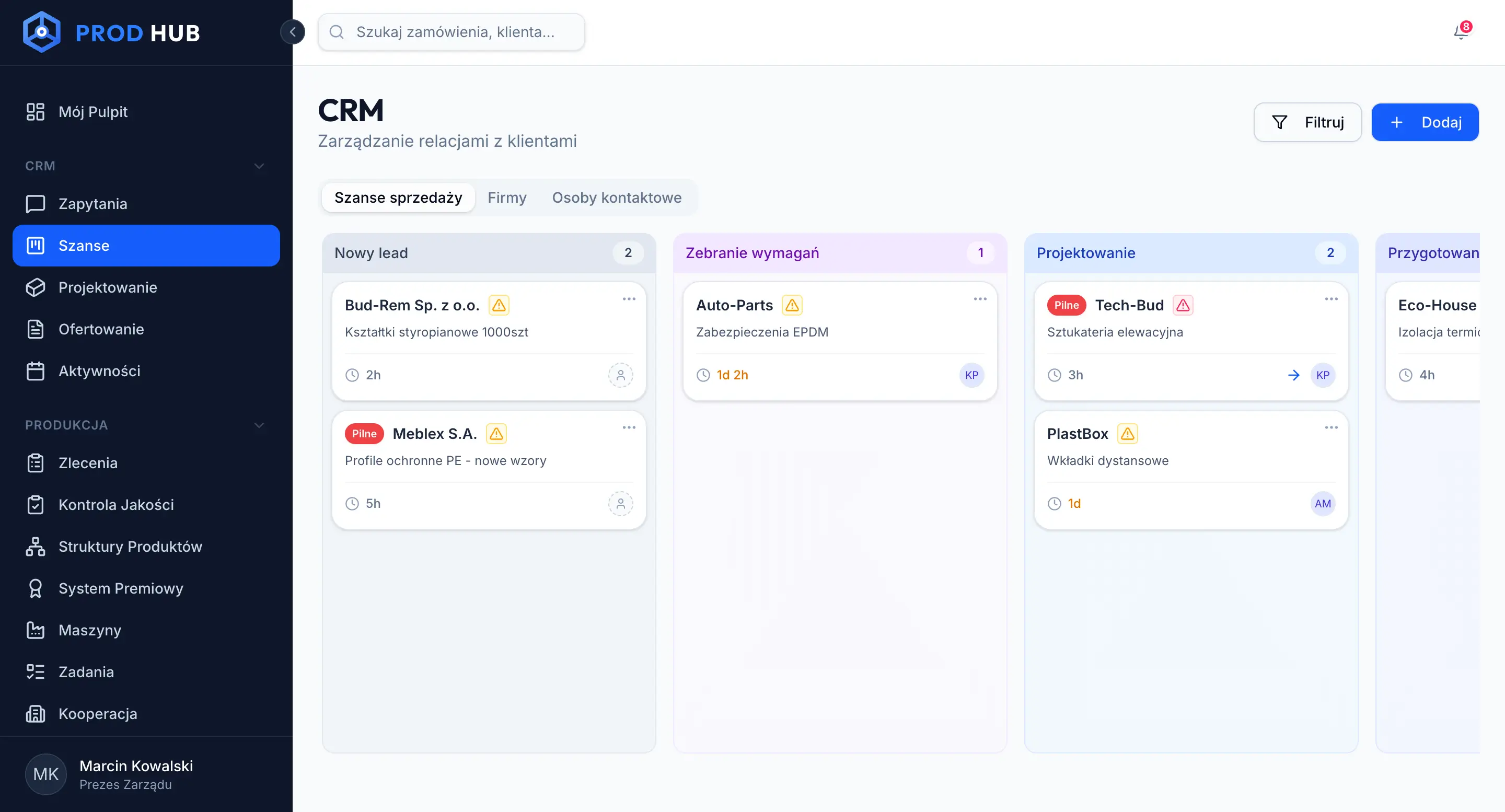
Until now, salespeople did not have any CRM system in which they could record potential sales opportunities. Clients contacted the company both by email and by phone, salespeople also worked in the field, directly in the clients headquarters. Therefore, the sales team needed an easy way to gather all the potential sales in one place.
We have implemented a query handling module in which it is possible to:
central collection of requests for proposals,
recording customer data and contact history,
sales funnel management.
CRM system module in software for production company
The system also saves a history of activity, which allows you to have a complete view of the course of contact with the customer. In addition, we have introduced a sales funnel view, enriched with a custom “design” stage. After moving the lead to this stage, it automatically goes to the next module of the system.
Design and nesting
When the trader moves the opportunity to the planning stage, the person in the design department receives an automatic notification that the next stage of work needs to be started. In the implemented production planning system, each application has a dedicated panel containing order details and access to nesting configurator. In the first stage, the employee models the product to be made for the customer — selects the appropriate base material (raw material) and defines the dimensions and parameters of the element.
Customizing an element in the Nesting Configurator
Next, the nesting algorithm in the production planning system analyzes the prepared model and calculates how many finished products can be obtained from one lump of material. In addition, it generates the course of the cutting line of the machine (expressed in running meters), which allows to accurately determine the cost of the material, the estimated time and operating cost of the machine (e.g. CNC) for the entire job.
Shipping of the offer
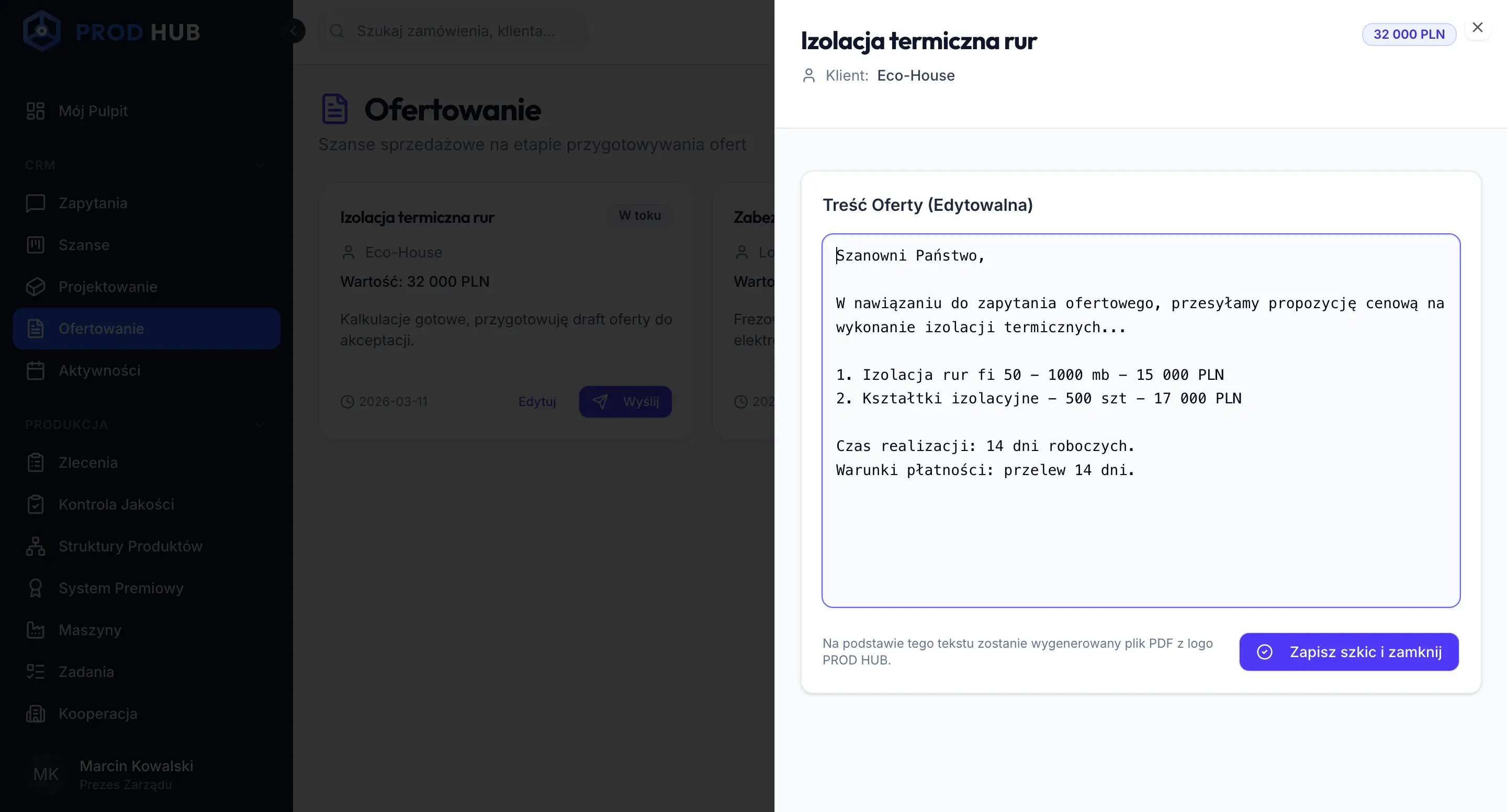
Once the planning stage is approved, the program automatically transfers the sales opportunity to “Prepare the offer”. From this view, it is possible to customize the content of the email, (including the price) and conveniently send the offer to a potential customer. The offer file is generated on the basis of information from the order, in the corresponding pdf template. Custom entries may also be added to the offer, depending on the type of product ordered (e.g. if the materials from which it is made are not weatherproof and must be properly stored).
Sample content of an offer email
The offer is immediately saved in the panel, and if the lead decides to buy the product, the merchant can mark it as “Won” or similarly if he gives up “Lost”.
Sometimes it also happens that before the customer decides to buy, another stage is added to the production process - the execution of the so-called test product, thanks to which the team knows whether it is possible and profitable to produce such an element at all. In our dedicated CRM system for a production company, we have added a special activity that allows you to order the production of a test piece. In this way, the quality department knows that it has to check the test piece and has a separate deadline set for this purpose.
Contact us and improve your production processes! We offer free implementation consultations
In the next view, you will find all the customer inquiries that have gone into the production phase. It not only allows you to view the order card in electronic form, but also to print it — using the paper version makes it easier for employees to preview them when they are already at the workstation in the production hall. This is a very useful functionality, since not every station has access to a terminal or computer.
The order contains, among other things, information about the number of pieces to be made or by when the order should be fulfilled. There is also space for manual entry of production results, information about deficiencies and for the signature of the operator operating the machine.
Each card also has a barcode that must be scanned at the end of the job to open the task view in the production program. It is there that the process of tracking the performance of the production process takes place.
Monitoring of production efficiency
The tasks module is used to report the production process — the employee enters in it how many good pieces were produced, how many deficiencies there are, i.e. unproduced elements, and for what reason (e.g. due to damage to the machine or lack of raw materials). Any employee who participates in the execution of a given order has access to such a panel — more than one person can be assigned to tasks in one order.
Preview of the production process of a given order
Thanks to the fact that efficiency is measured per employee, it is possible to view the profitability report of one person. On the dashboards we can see how many pieces a given employee produced, whether it is above or below the assumed standard, as well as how many defective pieces were created during his shift. Based on this, our production management software calculates bonuses. The company has a standardized bonus system in which a cash supplement is charged depending on the results. The application also allows managers to manually add the bonus and its justification.
Overview of the production process
In the panel of each order there is a history that shows the entire production process in clear steps. Thanks to this, the manager can find out in real time what stage a given batch is at. The production management system also shows if any of the tasks are delayed and for what reason.
A complete history of test piece approval is also available. Thus, in the event that a lot comes out defective, the company has access to data on whether the test piece was made and, if so, which auditor approved it.
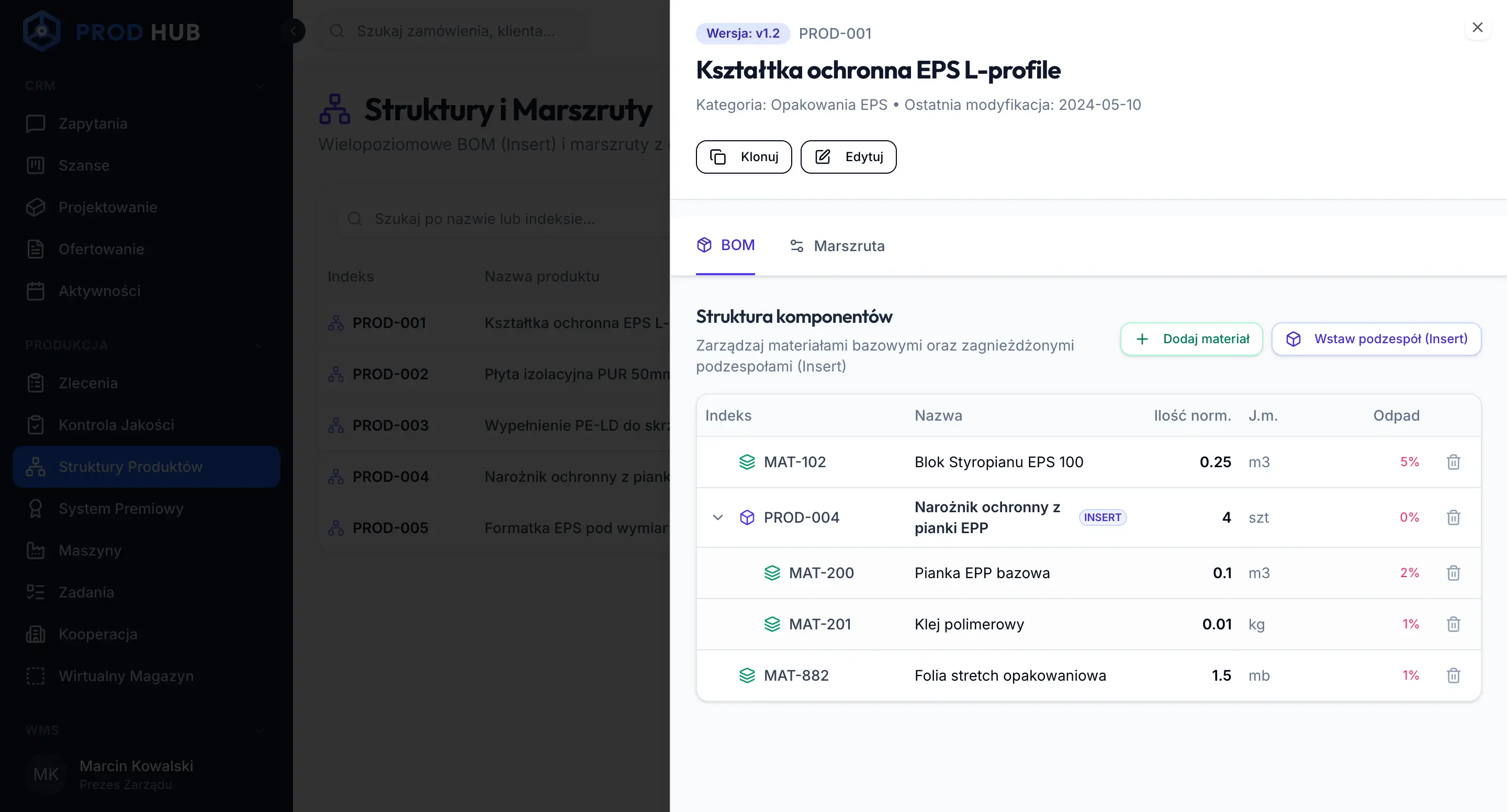
Structure Setting Module
In the system there is also a panel for setting the structure of the product, in which the company completes, the list of materials (Bill of Materials) needed to manufacture a given element and the individual steps of its production. If any of the elements is always externally executed, the corresponding status is set in the manufacturing instructions.
The individual stages of the production process described in the module structures
Based on this, the software for production knows what materials are needed to fulfill the order and reserves them in the warehouse in an automated way. In case of shortages, the system indicates which raw materials need to be replenished and in what quantity.
Cooperation with other manufacturers
As we mentioned in the paragraph about the process schedule, the production management software we have created also allows you to take into account the elements that the company produces externally. In a separate panel, managers can add third-party companies and subcontractors. Thanks to this, if in the production plan part of the operation requires external execution, this is appropriately marked in the system and does not disturb the internal efficiency indicators.
View stock and convert units
The production management system has also been integrated with the Subiekt, in order to conveniently view stock balances in real time. Thanks to this, the software provides information about whether the order data can already be completed or whether employees need materials for it that are currently unavailable.
Our client's problem was also the lack of the ability to conveniently convert warehouse units into production units. The workers in the production hall saw, for example, that there were 3 rolls of material in the warehouse, however, they did not have information on how many square meters were actually available. As a result, they had to manually carry out calculations, ask the storekeepers for the parameters of the rolls and waste time on additional findings.
The integrated production management system implemented by us automatically converts stock balances into real quantities of materials used in the production process. Thanks to this, the company eliminates the risk of calculation errors and significantly improves the daily work of the team. What's more, the company can easily update the conversion settings — for example, in the event of a change of supplier, when the amount of raw material per roll changes.
The warehouse module also displays information about materials assigned to specific production orders. Thanks to the automation of order processing in production, the system prevents the phenomenon of overselling — raw materials are automatically reserved, and with new production orders, a message, about the need to replenish them, appears. Bookings can be released at any time, allowing the sales department to respond flexibly to larger requests for quotations and manage material availability more efficiently.
Intelligent supply logistics
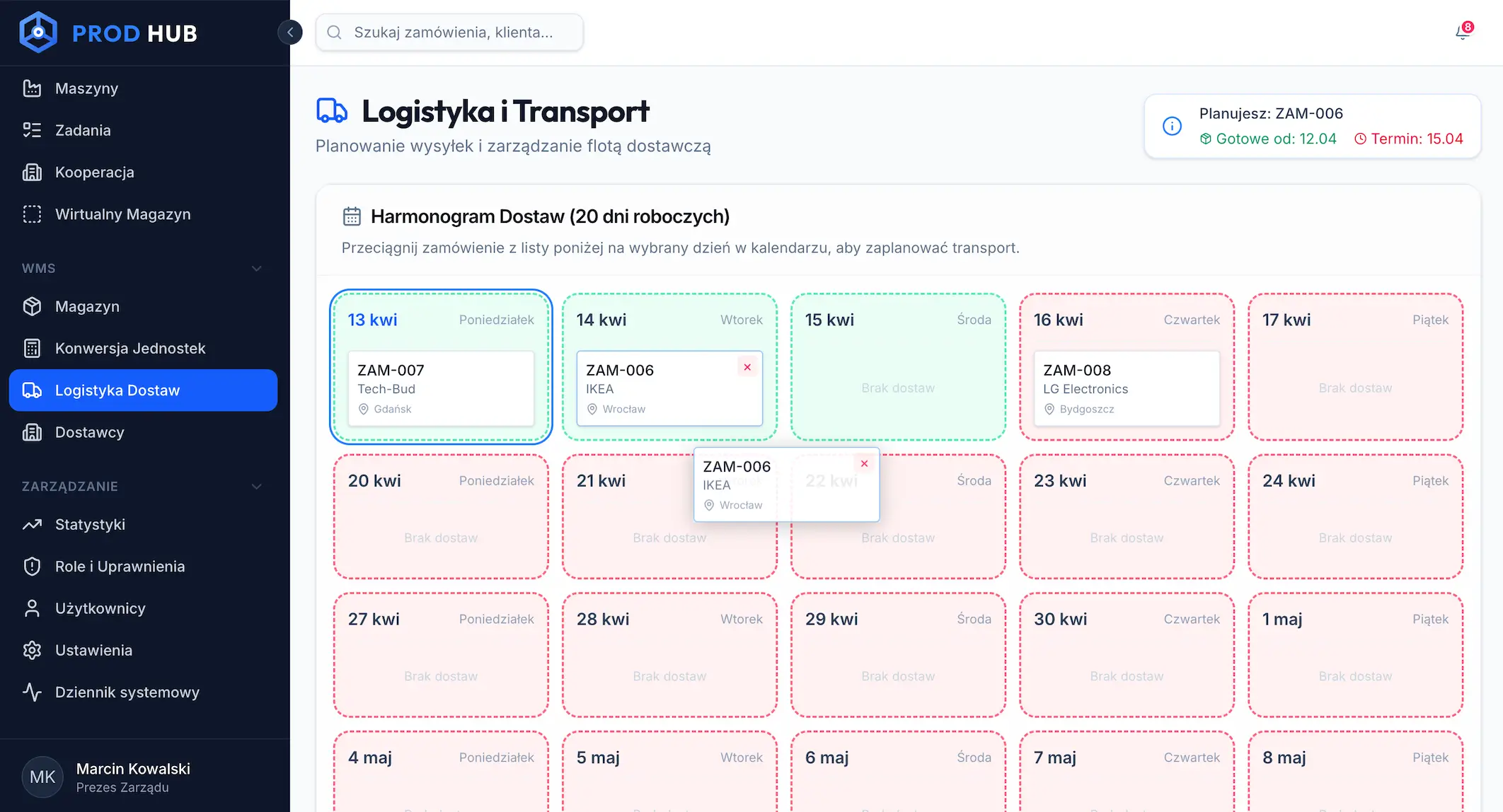
Automation of production order management has also been expanded with a delivery module. Thanks to the integration of all information — both about the time required to manufacture a given product and the deadlines expected by the customer — the system is able to precisely support the scheduling of production and related logistics processes.
Intelligent order shipping day management
In practice, this means that the software not only indicates when to schedule a shipment, but also takes into account the current production load, the availability of materials and the order in which the orders are executed. This allows the company to better synchronize activities between production and logistics, minimizing the risk of delays and downtime.
Moreover, the system regularly updates the recommended shipping dates in the event of changes in the production plan, such as shifts due to material shortages or prioritization of urgent orders. This approach significantly increases the predictability of processes and allows the company to more effectively administer the timeliness of execution, while improving communication both within the organization and with customers.
Benefits of implementing a production process planning system
The implementation of a system for managing production orders allowed the company to organize and automate key processes, significantly reduce the time for preparing quotes and fulfilling orders, as well as eliminate errors resulting from manual calculations. Thanks to full visibility of the production process and access to up-to-date data, the company has increased operational efficiency, better use of resources and can make more accurate business decisions.
Join our newsletter
Subscribe and receive additional content, checklists and business automation tips from us.
Thank you for subscribing to our newsletter!
You will soon receive a welcome message at the email address you provided.
Oops! Something went wrong, failed to send the form.
Do you want to implement production management automation in your company?
At Sagiton, we help companies in the manufacturing industry to increase the efficiency of their processes. Contact us and arrange a free consultation, after which you will receive an initial automation quote!
Bid Management Automation — how to speed up Offer Creation with AI
The process of creating offers is an integral part of acquiring clients in many industries, especially in the B2B sector. Read our article and learn how to speed up the sales process and respond to more inquiries at the same time, thanks to the automation of the creation of trade offers.
Read more
Business automation
07.07.2026
organising-tools-and-data-in-the-companies
Too many business tools? See How Automation Organizes Data
An overabundance of SaaS tools often leads to data dispersion, increased costs, and decreased operational efficiency. In the article, we explain how to organize the flow of information and build a scalable work environment through the automation of business processes.
Read more
No/low-code
07.07.2026
types-of-business-applications
Types of business applications and the motivations of the companies that order them
Business applications are not created “because you can”, but because they solve specific problems and support measurable business goals. In this article, we'll show you the most important types of applications and the real motivations behind the decision to order them — from organizing processes to scaling sales and automating customer service.
Read more
Contact us!
Select the topic you are interested in in the form and our specialist will contact you within 24 working hours.
Thank you for contacting us!
Your message has been successfully sent. We will reply as soon as possible.
Oops! Something went wrong, failed to send the form.


.gif)
.gif)