Read the article to learn about the actual cost of implementing artificial intelligence in a business and the factors that influence it, based on data from 2026 projects.
Implementing AI tools or automating processes? Know the difference
Before we answer the question of how much it costs to implement AI in a company, it is worth clarifying what this term actually entails. For some, implementing AI means providing employees with ready-made tools that use artificial intelligence. For others, it is comprehensive process automation where AI takes over some of the tasks previously performed by humans. Both approaches differ in scope, costs, and potential benefits.
Examples of ready-made solutions include:
a CRM system that automatically generates responses to customers,
marketing software that supports content creation using AI,
an FAQ (Frequently Asked Questions) chatbot that answers customer questions on a website.
In such cases, implementation often boils down to configuring the tool, purchasing the appropriate subscription, and organizing brief training for employees. The cost is relatively easy to estimate because it primarily includes subscription fees, configuration, and the time required for implementation and learning how to use the system.
Investing in business process automation using artificial intelligence, such as AI agents, is a different matter. Instead of adapting the company's way of working to a ready-made solution, we create software tailored to its actual needs. Such an AI implementation may include integration with existing systems, data analysis, decision-making based on specific rules, or the automatic execution of subsequent process stages.
This is a more advanced solution than a standard SaaS (Software as a Service) offering, as it requires analysis and the adaptation of technology to the company's specific processes. It involves a higher initial cost and longer employee training, but it also provides much broader opportunities for optimizing operations.
Why is it worth investing in more than just an AI tool?
Implementing artificial intelligence into company processes can bring significantly greater savings in time and resources than simply using ready-made applications. However, the condition is a proper identification of the organization's needs and the selection of areas where automation will truly provide benefits.
That is why we begin comprehensive projects with an analysis, often called an AI audit or technology consulting. Together with employees and the owners of individual processes, we identify repetitive activities, bottlenecks, and time-consuming tasks. Not every process is worth automating, and artificial intelligence is not always the best solution.
Based on workshops and collected data, automation specialists prepare recommendations and estimate potential benefits. They compare how much time individual processes take before and after AI implementation, what costs can be reduced, and what the investment itself will amount to. This makes it possible to calculate the ROI (return on investment) and determine which improvements have the greatest business justification.
Unlike ready-made tools, a dedicated solution adapts to the way the company operates, not the other way around. A well-designed AI agent can work with systems already in use, utilize company data, and perform tasks according to established rules.
How does this look in practice and what results can be achieved? We will show you using the example of a project implemented for our client, Anda Śruby.
Case study: AI agent for B2B customer service at Anda Śruby
The primary goal for Anda Śruby was to scale sales without the need for a proportional increase in headcount. However, the complexity of the sales process – which involved analyzing RFQs, identifying products, preparing quotes, and managing orders – proved to be a challenge. Due to the specific nature of the company's operations, a standard CRM or a single AI-powered tool could not comprehensively handle the entire process. Using several independent applications might have improved individual tasks, but it would not have provided cohesive automation across the entire sales pipeline.
That is why the company opted for a custom implementation, aimed not only at reducing manual labor and achieving cost savings but, above all, at creating a solution that supports further sales growth. Together, we designed an AI agent tailored to the company's actual needs and operational methods.
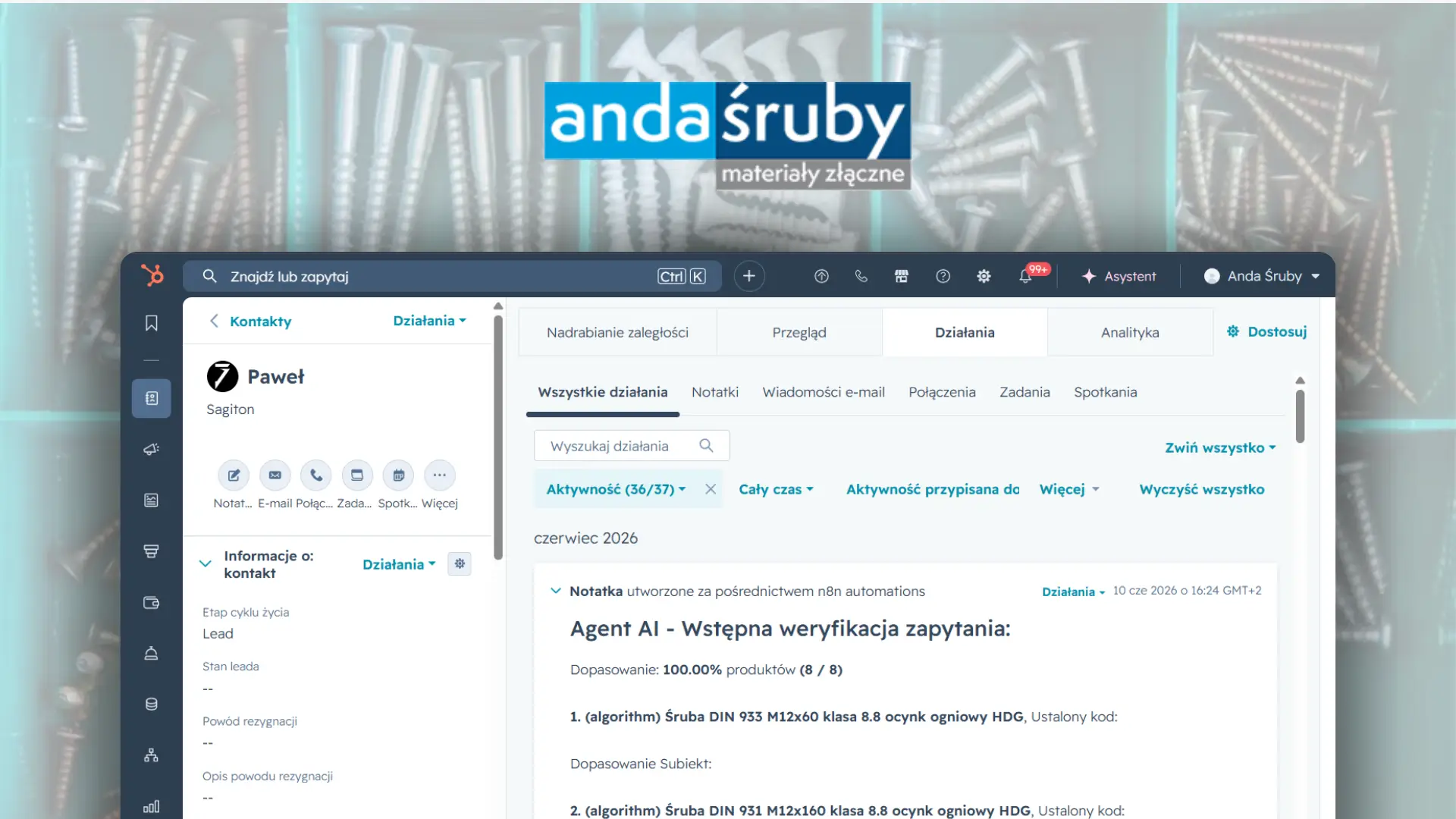
The AI agent supports B2B customer service from the moment an inquiry is received. It analyzes messages and attachments, identifies the products being ordered, helps match them to the company's inventory, and prepares the data needed to create a quote. By integrating with existing systems, it reduces the need for manual data entry and repetitive tasks performed by sales staff.
The scope described here is just one stage of the project. Anda Śruby continues to work with us, gradually expanding their AI solution with additional features. Even at this current stage, the automation saves up to 200 hours of work per month during peak periods.
Implementation time: 6 months Actual implementation cost: EUR 6800 Time saved: 200 hours per month Return on investment: 11 months from the start of the partnership
The Anda Śruby example shows that while a custom AI implementation requires a larger initial investment, well-chosen automation can pay for itself in a relatively short time, subsequently generating savings and increasing capabilities – such as handling more customers without a proportional increase in staff, as was the case here.
Sample costs for AI process implementation in 2026
The costs of implementing AI depend primarily on the size and complexity of the processes you want to automate. Below are estimated one-time costs, which do not include monthly subscription fees for AI models or integration platforms such as n8n.
Low-complexity process – EUR 800 – EUR 2300 – AI implementation requiring a few hours of analysis and simple API integrations. Examples of processes:
automatic generation of responses to customer emails,
invoice recognition and description.
Medium-complexity processes – EUR 2300 – EUR 6800 – automations requiring data analysis from multiple sources and the preparation of a more extensive system architecture. Examples:
automatic lead scoring,
classification and assignment of customer tickets.
Complex processes – EUR 6800 – EUR 25000 – solutions requiring advanced data processing, integration of multiple systems, and often a dedicated dashboard for process management. Examples:
automatic analysis of technical documentation and CAD files,
automation of expense invoice circulation and verification.
Highly complex processes and AI systems – from EUR 25000 upwards – extensive applications where AI is part of a larger system, involving advanced integrations, business logic, and dedicated interfaces. Examples:
comprehensive automation of B2B quote requests integrated with an ERP system,
intelligent system for analyzing and handling corporate correspondence based on an extensive knowledge base.
As you can see, implementation budgets can vary significantly. We price each project individually, taking into account the scope of analysis, the number of integrations, the complexity of the processes, and the time required to design and program the system. Unfortunately, with this type of implementation, it is difficult to establish a price list that would apply to different processes – which is why we usually prepare quotes for our clients based on an hourly rate.
Get a quote for implementing AI in your processes! Fill out the form, and our specialist will schedule a free online consultation for you.
The hidden cost of AI implementation – what to watch out for?
One of the biggest challenges in implementing artificial intelligence is getting employees accustomed to new ways of working. Even the best-designed automation will not deliver the expected results if the team does not use it. Employees may be reluctant to changeand, out of habit, continue to perform some tasks manually. That is why it is worth including training, proper communication, and the time needed for team adaptation as early as the implementation planning stage.
The second important issue is choosing the right areas for automation. The highest ROI is achieved where AI helps eliminate the most time-consuming and repetitive tasks, such as handling customer correspondence, summarizing meetings, or preparing sales proposals. However, not every task is worth entrusting to artificial intelligence. An example would be generating detailed product photos, which require high precision and consistency with the actual appearance of the product. Due to the risk of errors and the need for repeated corrections, the cost of labor spent on verification can exceed the price of a professional photo shoot.
Therefore, when assessing the profitability of an AI implementation, one must consider not only the cost of creating the solution but also the time required for its maintenance, result monitoring, and potential corrections. Only this approach allows for an accurate assessment of real savings and avoids a situation where automation, instead of reducing work, generates additional duties.
What ROI (return on investment) can I achieve from AI implementation?
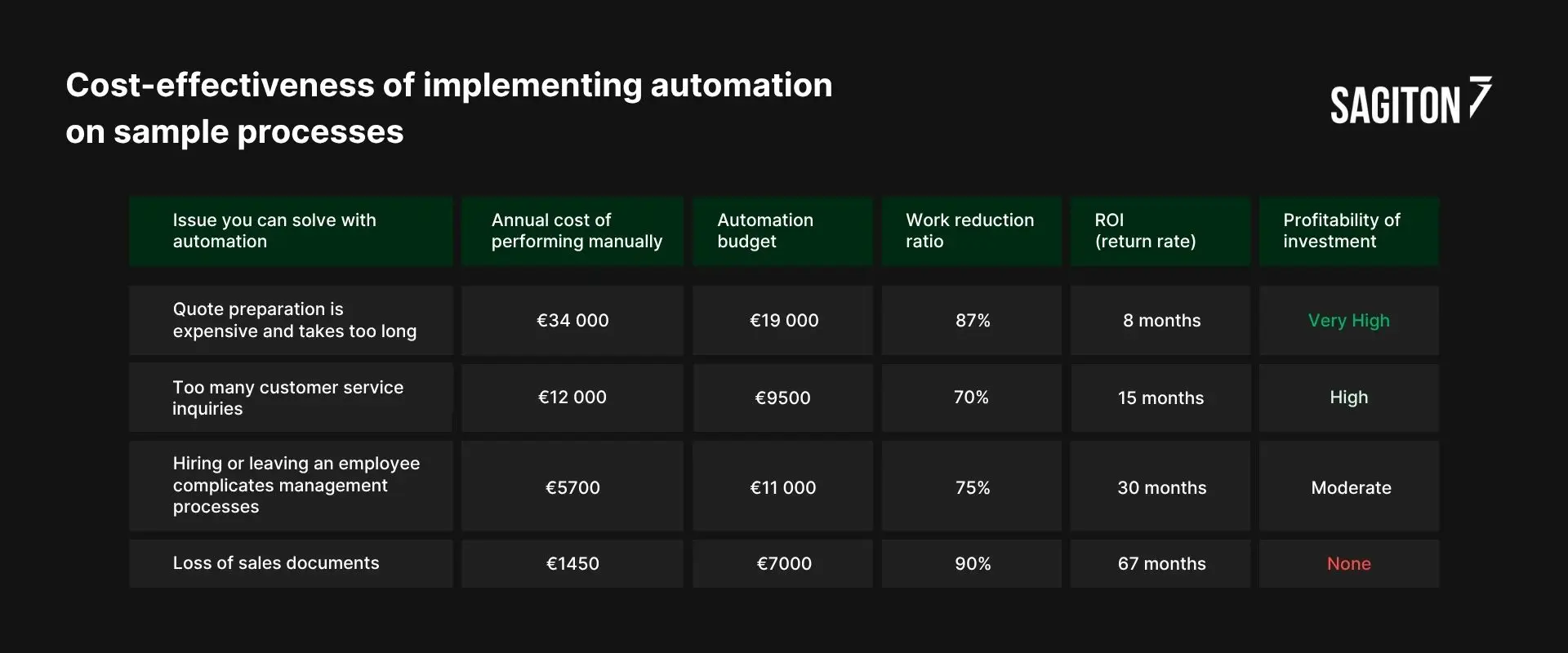
Although using artificial intelligence in a company comes with certain pitfalls, properly planned automation can bring very tangible financial benefits. At Sagiton Automation, we have repeatedly helped our clients achieve a profitable ROI, and in some cases, the costs incurred were recouped after just a few months.
In our case studies, based on real-world implementations, we calculate ROI primarily by comparing the monthly number of saved man-hours, the cost of specialist labor, and the amount the client spent on the project. This allows us to estimate how long it will take for the savings to cover the initial investment.
It is worth remembering, however, that such calculations only take into account the most measurable benefits. We base them on data provided by the client, so the actual savings may be significantly higher. To understand the real cost of not making improvements and to estimate ROI more accurately, one would also need to include the reduction in employee errors, shorter task completion times, and increased efficiency across the entire organization. For example, faster customer service in B2B sales can increase the chances of winning a contract, thereby directly impacting company revenue.
How does this look in practice? Below are specific figures showing how long it took for our clients' budgets to break even:
Anda Śruby – AI customer service agent: 11 months from the start of the partnership.
AI bot for automatic competitor price monitoring: 3 months from the launch of the solution.
AI-powered proposal automation for a consulting firm preparing complex business offers: 4 months from system completion.
As the examples above show, the time required to achieve ROI can vary significantly. It depends primarily on the scale of the project, the number of processes being improved, the costs incurred, and whether artificial intelligence is replacing manual work entirely or simply supporting employees in specific tasks. In many cases, such as the project for Anda Śruby, some tasks are still performed by humans, while the technology allows them to handle a higher volume of inquiries without a proportional increase in headcount.
Under favorable conditions, a return can be achieved in just a few weeks. However, this does not mean that every project should yield such rapid results. For AI projects in small and medium-sized enterprises, a 12-month period can be considered a reasonable benchmark for profitability.
If an investment pays for itself within a year, it is generally a very good result, especially when the technology used also provides benefits that are harder to quantify directly in monetary terms.
In summary, is it worth investing your budget in AI solutions in 2026?
Definitely. Investing in artificial intelligence can be profitable not only for large organizations but also for SMEs. Properly selected AI solutions help reduce operating costs, save employee time, and increase efficiency without the need for a proportional increase in headcount. Moreover, some projects pay for themselves in just a few months, generating further savings in the long term.
So, if rising daily operating expenses are straining your company's budget, it is worth considering which tasks could be streamlined with the help of artificial intelligence. The key to success, however, is choosing the right areas and accurately estimating the potential benefits. Working with an experienced AI agency allows you to avoid unnecessary costs and plan the project so that it begins to deliver measurable results as quickly as possible. It is also worth remembering that you don't have to change the way your entire organization operates all at once. A much more sensible approach is to implement AI in stages, starting with the single process that offers the greatest potential for savings. Once the results have been verified, you can gradually expand improvements to other areas of your business.
Would you like to know specific price ranges for your process? Contact us! At Sagiton Automation, we will help you estimate the one-time cost of project implementation, as well as ongoing expenses related to monitoring AI systems, their maintenance, and tool subscriptions. This will help you determine what budget to allocate for artificial intelligence and when you can expect a return.
Join our newsletter
Subscribe and receive additional content, checklists and business automation tips from us.
Thank you for subscribing to our newsletter!
You will soon receive a welcome message at the email address you provided.
Oops! Something went wrong, failed to send the form.
Contact us to get a quote for AI automation
Visit our contact page and submit the form, and one of our specialists will get in touch to provide a free quote for a custom AI-powered solution tailored to your needs.
Too many business tools? See How Automation Organizes Data
An overabundance of SaaS tools often leads to data dispersion, increased costs, and decreased operational efficiency. In the article, we explain how to organize the flow of information and build a scalable work environment through the automation of business processes.
Read more
Business automation
07.09.2026
cost-of-business-automation
Cost of business automation – prices and ROI in 2026
Read the article to find out how much business automation costs and what factors determine the total price of enterprise automation in 2026.
Artificial intelligence (AI) promises to revolutionize business — from implementing process automation to precise forecasting. However, reality often deviates from expectations. Read our article and learn about 5 real examples of the difficulties that organizations face when implementing AI.
Read more
Contact us!
Select the topic you are interested in in the form and our specialist will contact you within 24 working hours.
Thank you for contacting us!
Your message has been successfully sent. We will reply as soon as possible.
Oops! Something went wrong, failed to send the form.