AI agent is a relatively new term that emerged in the broader business world alongside the popularization of AI tools like ChatGPT. It is no surprise, then, that not everyone is yet familiar with what an AI agent actually is, how it is implemented, or how long the process takes. Read our article to find the answers to these questions.
In 2026, deploying a simple AI system in a company can take from 2 to 4 weeks, while for more extensive business process automations, it typically takes between 1 and 3 months. Projects involving the integration of multiple systems, processing large datasets, and automating complex workflows can require up to 6 months of work. In this article, we'll explore what influences project timelines and what the first step of an implementation looks like.
But first – what exactly is an AI agent?
An AI agent is a system powered by artificial intelligence that independently handles tasks and business processes. Unlike traditional automations that run on predefined rules, an agent can analyze information, interpret its context, and decide on the next course of action. This makes it ideal for processes where it's difficult to predict every possible scenario.
AI agents and assistants are used in many areas of business operations, including:
customer service,
document analysis,
sales and marketing,
data management.
For example, they can analyze messages, identify customer intent, search for information in company systems, and prepare responses without requiring employee involvement at every step.
Although AI-based systems often feature complex architectures, not every AI agent implementation requires building software from scratch. Agents can also be built using popular automation platforms like n8n or Make. In this approach, the traditional workflow is enhanced with AI, which handles data analysis, information interpretation, and specific decision-making. The remaining operations continue to run on standard automation rules.
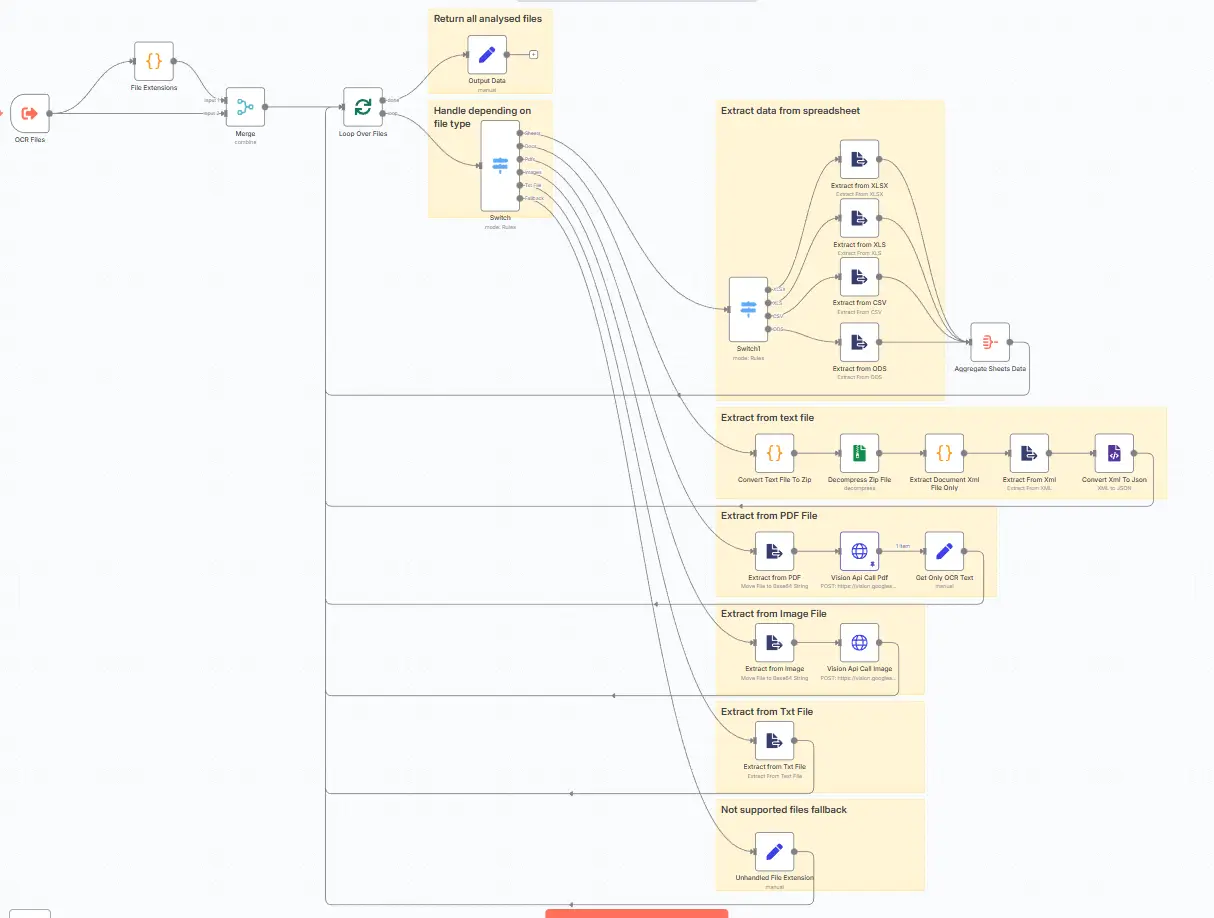
Below, we present a fragment of an actual workflow we implemented for one of our clients.
The system processes documents in various formats, identifies their type, and routes them to the appropriate analysis pipelines. It’s an example of a project that combines traditional automation with the capabilities of AI – userd where rigid rules alone fall short.
Where to start with AI automation?
Implementing AI in a company often involves much more than simply choosing tools for employees to use. For automation to deliver tangible benefits, it’s best to take a comprehensive approach – starting with a thorough analysis of business processes and concluding with the integration of new software into your existing company systems.
The most cost-effective approach is to implement agents that work with the tools already used in the organization. This way, employees don't have to constantly switch between different programs, and the entire business process can be carried out within a single, cohesive work environment.
However, such an AI implementation strategy requires proper integration planning and system architecture preparation. That is why at Sagiton, we typically begin AI agent implementations with a thorough analysis of the company's needs and processes. We divide the entire journey from concept to launch and monitoring into 7 specific steps, which we outline below.
7 stages of AI implementation in a company
The timeline for implementing AI in a company primarily depends on the complexity of business processes, data availability, and the scope of integration with existing systems. For simple automations, companies may choose to handle the implementation in-house, skipping some of the steps outlined below. However, with mid-sized and larger projects – especially those spanning multiple business processes or requiring several system integrations – we should have in mind a more comprehensive approach.
Below, we present the 7 stages of AI implementation in a company, reflecting how we carry out such projects at Sagiton – from the initial client conversation, through analysis and solution design, to launch and monitoring. For each stage, we also indicate its estimated duration.
1. Contacting an AI agency
Although some companies decide to implement AI on their own, it is important to remember that knowledge of the latest AI tools and models is not always sufficient to carry out such a project. In the case of more complex business processes, expertise in system architecture design, software integration, and data security is equally critical.
AI agencies help companies implement new technologies in a way that is tailored to their specific business operations. At Sagiton, we begin our collaboration with an online conversation, during which we learn about the organization's needs, its business goals, and the challenges employees are facing. Based on this, we identify potential directions for automation and propose the next steps.
Duration: If you reach out to Sagiton via email or our contact form, our consultant will typically get back to you within an hour to schedule an online meeting, and the consultation itself will take no more than 45 minutes.
2. Audit or process analysis
Before designing any automation, AI specialists need to gain a thorough understanding of how your company works. This usually takes place during discovery workshops – where specialists, either online or on-site, examine how your teams work, the systems in use, data flows, and the tasks that consume the most employee time.
Specialists also prepare a process map, identify areas requiring optimization, and recommend changes to how they are executed. They determine which tasks can be automated, where human involvement is still necessary, and which technologies will work best in a given case.
A crucial element of the analysis is also assessing the ROI of the implementation. Based on the insights gathered, the AI agency should provide estimates for potential time savings, operational cost reductions, and the overall impact of automation on organizational efficiency. This allows you to collaborate on setting implementation priorities and focus your investment on the areas that deliver the highest business value.
Duration: From a few days up to 3 weeks for large-scale projects.
3. Selecting the right tools
Only after conducting a business process analysis can specialists provide specific recommendations regarding the choice of tools and technologies. Their selection should consider not only the functionality of individual systems but also integration capabilities with existing infrastructure, data security, scalability, and maintenance costs.
Initial technology recommendations may emerge during early conversations with the AI agency; however, even for simple automations, it’s essential to first understand the needs of the people involved in the process. Technology choices should always be driven by business needs, not the other way around. This prevents unnecessary software subscriptions and avoids implementing systems that could hinder future automation growth.
Duration: Typically carried out during the audit or immediately after its completion.
4. Setting priorities and an implementation schedule
Based on the analysis, the agency will prepare a detailed roadmap outlining how the AI implementation will unfold across your organization. A key component of this step is establishing implementation priorities – determining which processes should be automated first by weighing potential business benefits, costs, and technical complexity.
Preparing an AI strategy also involves dividing the project into individual phases, estimating the workload, and determining dependencies between the various elements of the system. This approach allows for working on the project gradually, verifying the effectiveness of individual components, and achieving initial business benefits before the entire system is completed.
At Sagiton, we present a preliminary implementation schedule to clients during initial discussions, while a detailed version – incorporating the results of the business process analysis, technological recommendations, and the final implementation cost – is provided along with the post-audit report.
Duration: Our consultants will prepare your roadmap within a few days following the audit.
Find out how much it would cost to implement AI in your business! Book a free online consultation and get a personalized quote.
Once the schedule is approved, the AI agency will begin building the agent, configuring individual components, and integrating them with the systems used in your company. Depending on the scope of the project, the work may range from preparing a simple AI chatbot to support employees with daily tasks to building an extensive system that automates entire business processes.
Project delivery time depends not only on the size of the implementation team or the complexity of the solution, but also on data availability and quality, API integration capabilities with existing systems, and the technology partner's experience. If an agency has already worked on similar projects, it can use proven components, integration frameworks, and architectural patterns, significantly reducing the overall project delivery timeline.
For more complex projects, the AI agency may suggest preparing a Proof of Concept (PoC) – a project approach that allows you to verify the effectiveness of the chosen technology using real data before starting full implementation. This helps reduce investment risk and confirms the validity of the initial assumptions.
Duration: Typically anywhere from 2 weeks to a few months, and in rare cases, over 6 months.
6. Conducting tests
In this step, the automation agency will verify that the system operates according to the established requirements and that the AI agent's output meets expected results. Typically, at this stage of the project, specialists will provide you with access to the agent so your team can test its performance using your company data – for example, testing various customer inquiry formats in the case of automating a quoting process.
After successful testing and any necessary adjustments, the system will be deployed into production. At this phase of the project, the AI agency should also offer you support regarding monitoring and further software optimization.
Duration: Testing the complete system before handing it over to your team usually takes a few days. For larger projects, rollouts are often phased so your company can start benefiting from improvements even before everything is fully completed.
7. System monitoring and post-implementation support
Launching an AI assistant in your company does not mean the work on the system is finished. To ensure that AI implementation for businesses is safe and effective, the automation agency should implement appropriate security measures during the solution-building stage and then deploy automatic monitoring mechanisms. These will allow you to control the agent's accuracy, identify errors, and – in the case of high AI usage and token consumption – monitor its operating costs.
Many companies choose to maintain an ongoing partnership with their software provider even after the implementation is complete. Business needs, regulations, and company operations can change, so it is worth ensuring that the automation agency offers post-implementation support, ongoing maintenance, and the ability to further expand the system.
Duration: Depends on the scope and the specific terms of cooperation with the AI agency.
We guided our client Anda Śruby through all the project phases mentioned above, implementing an AI system that automates customer service. It is a relatively large-scale project whose core phase was completed after 6 months. Our developers continue to work with the client, further developing and monitoring the system. Read our case study to learn more about how our custom AI agent works and how much Anda Śruby saves thanks to it: https://www.sagiton.pl/en/case-studies/implementation-of-ai-agent-in-customer-service
In summary – how do we implement AI at Sagiton?
Every company operates differently, which is why the way an agent is implemented varies based on individual business needs. At Sagiton, we help companies navigate the entire digital transformation process with AI implementation – from identifying AI potential and designing and building dedicated systems to maintaining and further developing them – regardless of whether the company already knows what they want to program or is just looking for the right ways to improve their processes.
Now you know what each phase of an AI project looks like. If you're still wondering how long it takes to deploy a medium-complexity AI agent in 2026, here is a quick summary of the key takeaways:
Contacting an AI agency – 1 hour
Process analysis – 2 weeks
Selecting the right tools – during the audit
Setting priorities and a schedule – 3–5 business days
Implementing AI solutions – 4–6 weeks
Conducting tests – 1 week
System monitoring and post-implementation support – ongoing, according to the terms of cooperation
The total implementation time for a medium-complexity agent is therefore around 2 months. Keep in mind, however, that individual phases can be carried out in parallel, allowing you to shorten the overall project timeline if a fast turnaround is your priority.
Join our newsletter
Subscribe and receive additional content, checklists and business automation tips from us.
Thank you for subscribing to our newsletter!
You will soon receive a welcome message at the email address you provided.
Oops! Something went wrong, failed to send the form.
Want to find out how long it would take to implement AI in your company?
Schedule a free consultation with our specialists to discuss the tasks you would like AI to support you with. During the call, you will learn how much a dedicated system would cost and what factors influence the price.
Agentic Commerce is the next step in the evolution of digital commerce, where technology really takes over the actions of the customer and the seller. Read the article and learn how AI in an online store is no longer an add-on in the form of a chat, but becomes an active agent that searches, recommends, orders and supports end-to-end sales processes.
Read more
Business automation
16.11.2026
ai-implementation-prices-roi-in-2026
How much does it cost to implement AI in a company? Prices and ROI for 2026
Read the article to learn about the actual cost of implementing artificial intelligence in a business and the factors that influence it, based on data from 2026 projects.
Read more
Business automation
07.07.2026
implementing-ai-in-business
Implementing AI in Business – How to Choose the Right Solutions? Practical Case Studies
AI-powered process automation enables companies to complete tasks more quickly and reduce daily operational costs. Learn what to consider to achieve your intended results.
Read more
Contact us!
Select the topic you are interested in in the form and our specialist will contact you within 24 working hours.
Thank you for contacting us!
Your message has been successfully sent. We will reply as soon as possible.
Oops! Something went wrong, failed to send the form.