Read the article and learn about sales automation solutions for B2B companies. Find out what improvements are worth implementing and where to start automating this area.
What does sales automation look like in different business sectors?
Automation of sales processes may look different depending on the type of business being conducted. In the case of e-commerce, it includes, among others, dynamic pricing in marketplaces or product recommendations. In the B2C services sector, it most often concerns the automation of email marketing and solutions that improve the quality of customer service (e.g. personalized discounts for subsequent services).
In this article, however, we will focus on sales automation in the B2B sector, that is, in an area where direct relations with the client, conducting sales meetings, effective management of the sales funnel and reporting of results are crucial.
The key difference between B2B and B2C is the customer's perception of automation. In B2C, automated messaging (e.g. SMS) is standard and widely accepted practice. In B2B, on the other hand, excessive automation of communication can be perceived as a lack of individual approach. For this reason, automation for the sales department in B2B often involves mainly internal processes, invisible to the clients. Below you will find an example of how such a process takes place.
What can an automated sales process look like in B2B?
The sales process usually starts from the moment a lead converts through the website. Information about a new query is automatically sent to the selected communication channel (e.g. Slack, Microsoft Teams), while assigning the appropriate salesperson and adding contact details to the CRM system. Thanks to this the reaction time is significantly reduced, and the process does not require manual data entry.
The next step may be the use of tools based on artificial intelligence to carry out the so-called lead screening, i.e. collecting and presenting the most important information about a potential client. This allows the trader to better prepare for the first contact.
The automation system can also send notifications in the situation when the lead is not handled quickly enough. In the case of an online appointment, it is possible to automatically create notes and tasks for the trader. Thanks to this, the CRM system supports the management of the sales process, and the assigned tasks are carried out in an orderly and timely manner.
Case study: Implementation of sales process automation in a CRM system for a service company
We were approached by a company from the B2B service sector, which was facing the problem of low efficiency of sales processes and the lack of a coherent organization of sales activities. The organizational structure included four sales teams, each of which was responsible for a different type of service. However, all customer queries were sent to one common source, which required manual verification and assignment of leads — first to the relevant specialization, and then to a specific salesperson. Such a repetitive, manual process not only increased the response time to queries, but also generated ambiguities related to the distribution of leads, which in the case of the remuneration model based on the commission (success fee) negatively affected the cooperation and motivation of the team.
As part of the implementation, we carried out process optimization, and then automation of the distribution of requests. Four dedicated contact forms were used, corresponding to different categories of services, which made it possible to automatically assign leads to the right teams at the stage of their acquisition. Subsequently, it was implemented mechanism of rotary assignment of contacts within teams, which allowed for a more even distribution of work and the elimination of disputes related to access to potential customers.
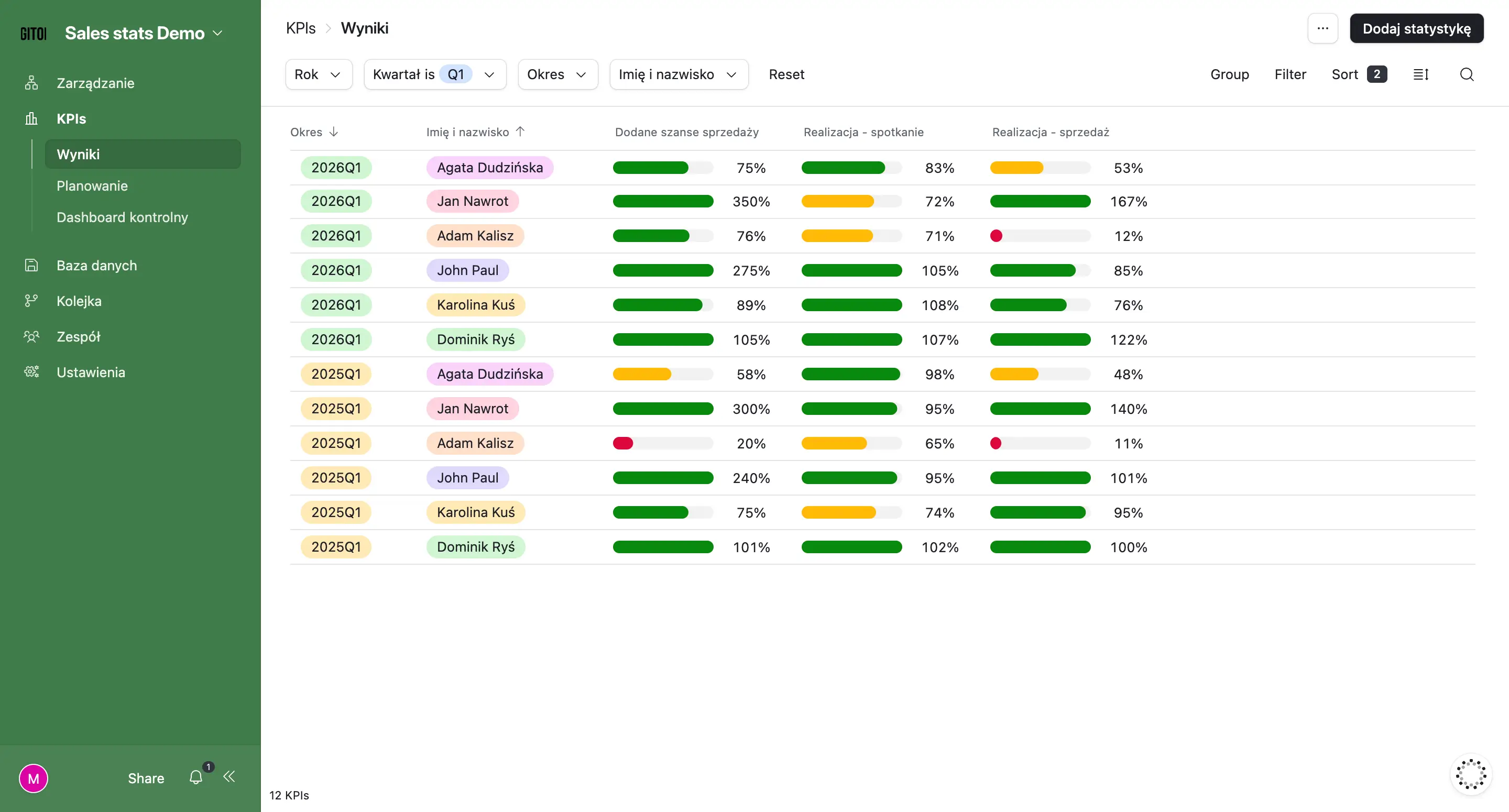
In addition, the CRM system has been expanded with dashboards to track results and ongoing analysis of the effectiveness of sales activities. Thanks to this, the company can now monitor conversions, identify areas for improvement and transparently compare the performance of individual traders.
Demo of sales dashboards to compare the effectiveness of traders
Implemented solutions made it possible to significantly reduce the response time to inquiries, improve customer service and streamline the sales process. Automation eliminated repetitive administrative activities, which translated into an increase in the efficiency of the team's work. As a result, leads are taken up faster, the sales process has become more transparent, and salespeople — thanks to clear rules and access to data — show a higher level of commitment and motivation to achieve their goals.
Details of the implementation Project length: 1 month Cost of the project: EUR 8300
Do you want to implement a similar sales automation solution for service companies? Contact us and arrange a free consultation with our specialist!
What is the cost of implementing automation in sales?
The cost of implementation depends largely on what part of the process you want to automate and what tools your company uses.
Most modern sales tools such as CRMs or marketing automation systems allow easy connection via API or ready-made integrations. This allows fast implementation of fundamental improvements, for example, automatic data transfer or sending notifications. However, it can be more expensive to connect to older applications that even do not have a web version - as more technical work is required to integrate such tools.
As for the complexity of the processes, the cheapest for automation will be those processes in which data is simply transferred (for example, from forms to the CRM system or to the company messenger). Such implementation in cooperation with an automation agency starts at EUR 500. More expensive will be more complicated processes that rely on more than just sending data at the right time and in the right format.
An example of more expensive automation could be, for example, allowing traders to manage leads directly from the messaging app (e.g. Slack, Microsoft Teams) — change statuses, add notes or send information without having to log into CRM. Automation allows in this case to reduce the repetitive nature of work, ensure time savings and put the process in order. Such implementations begin usually from about EUR 2500, because they combine multiple applications and trigger the execution of different actions. Read more about lead automation in our article “Sales automation — handling leads from the phone”.
However, the most expensive automations are those improvements in which the algorithm must create/generate something. Most often, in such projects, we simply use artificial intelligence. Examples of the most expensive sales process automation:
Generate prompts for sellers — the algorithm analyzes the previous contact with the customer and advises sellers on personalized follow-ups, upsell or cross-sell at the right time.
Generating summaries of conversations — thanks to the right technologies, we are able to record conversations so that the AI can create a summary based on them and generate a PDF that the salesperson can send to the client.
Automated bids — the AI will make the necessary calculations and generate an offer based on the appropriate template.
These types of solutions require a more advanced approach to design and testing. In the case of standard automations based on specific rules and algorithms, we are able to accurately predict their operation — if we do not make changes, the system will perform the same actions in a stable and repeatable manner.
Whereas automation with AI is more unpredictable — we never know what result AI will return to us, so its application requires a longer phase of testing and the creation of appropriate prompts (instructions for the AI model), thanks to which the automation will know what mistakes not to make.
As a result, the implementation of such solutions is more time consuming, but at the same time gives the greatest potential in terms of increasing efficiency and scaling processes. The cost of such projects usually starts at $7000.
Modular automation for sales departments — a cheap alternative
As you can see, the implementation of sales automation in B2B can require different budgets, and in fact with an individual project tailored to the internal processes of your company, the automation agency will prepare an individual quote for you anyway. Unfortunately, budgeting, especially larger amounts, is dragging on in many enterprises, and the specification of automation is such that the sooner you implement it, the sooner you start saving.
Therefore, to help our clients implement improvements faster, we have created sales automation modules. These are ready-made, proven solutions that address the most common needs of sales teams and can be implemented in the subscription model, without having to commit a large budget at the start — their monthly subscription starts at $80 per month. Each module includes specific tools to support selected areas of work — from lead handling to quote creation to reporting — and can be easily combined with others to create a cohesive sales automation system.
With such modular automation, it is possible to rapidly reduce the repetitive processes, which translates into real time savings and an increase in sales efficiency from the first weeks. Importantly, the modular approach allows you to gradually develop the system — the saved resources can be used for subsequent implementations, and the whole can be expanded in a flexible way, adapted to the growing needs of the company. You can learn more about our sales automation modules and their functionalities in the article: https://www.sagiton.pl/en/blog/cheaper-sales-automation
Where to start automation for the sales department to optimize profits
When we implement automation in our clients' companies, in most cases we start by conducting an audit. The audit is nothing more than a set of meetings with the stakeholders chosen by the client, during which we find out how the business processes in their company are going. The result of the audit (workshops) is the so-called post-workshop report, in which our client sees what workflows and repetitive tasks are worth automating, how much ROI (return on investment) of optimization will be, as well as what problems we may encounter during implementation. In the report, we also prepare a list of relevant tools that we will use to create automation in your company. See what the post-state report looks like, which our clients receive after a process audit: https://www.sagiton.pl/en/services/business-process-audits
Without an audit of selected processes, it is difficult to assess where it is best to start a project, whether it will be profitable and how long it will last. Therefore, we always recommend our clients to start a project with such an audit analysis.
So the first step is usually analysis — but what happens after it? In most cases, after the audit, we look at which activities in the company take up the most manual work and start automation precisely from them. Thanks to this, our client sees real savings in time and budget after the first stage of the project and can allocate his resources for the implementation of further improvements. Often, the first workflow that we automate is the most error-prone — because frequent manual errors can be disastrous for companies (e.g. posting an incorrect invoice or sending a report created on the basis of data from another company to the customer).
However, when it comes to automation for the sales department, the matter is somewhat different. When clients come to us with an idea for such an improvement, they often want to simply increase the level of sales and sell more through automation. As we wrote above in the case study section — the client's problem was the low efficiency of sales processes, and automation was a key element of improving the sales cycle. Thanks to it, not only the involvement of traders has increased, but also the satisfaction of customers, who now receive a response from sellers faster. All this, in the long run, has led to an increase in the number of closed sales opportunities.
So remember, when thinking about improving the sales area in your company, that the greatest effects are brought by the automation of those activities that directly affect the speed of response to leads and the quality of customer service.
Examples of automations that improve sales results
Now you know that it is not worth looking only at activities that take a lot of time, but above all at those that really affect the results. Automation of sales processes allows you to organize the activities of salespeople and increase efficiency at each stage of the funnel. Below you will find examples of improvements that can positively affect the results of the actions of sellers:
Automatic follow-ups after contact with the customer — regular contact ensures that the customer does not forget the offer and significantly increases the chance of closing the sale
Automatic Qualification of Sales Opportunities — salespeople focus on the most valuable contacts, which increases the effectiveness of sales activities
Automatically assign leads to traders — reduces the response time to an inquiry and allows you to start conversations with a potential client faster.
Email sequences (nurturing) — automatic email personalization maintains interest in the offer and guides the customer step by step to the purchase decision
Conversation transcripts and automatic meeting summaries — after the interview, the client receives a PDF with the most important findings and next steps, giving them full insight into the findings and a greater sense of control.
In conclusion, well-designed digitalization not only improves the work of the team, but above all increases the predictability and effectiveness of activities, which directly translates into higher sales results.
Automation of sales processes - what is worth remembering
When thinking about digitizing the work of the sales department, it is worth remembering that the key step is the audit of processes, which allows you to identify areas for optimization and realistically assess the potential for growth of sales results. Unfortunately, often companies that want to implement sales automation do not have a way to compare IT agencies, because all of them, instead of estimates or proposed steps, offer them precisely an audit. In the approach of first audit, then valuation, you do not really know if the agency is reliable, if it delivers functionalities on time, or if your team will work well with it. However, in order to compare several automation companies against each other, your company would have to purchase several audits — sounds pointless, right?
Therefore, at Sagiton, we offer our potential customers the opportunity to carry out a test automation project, for which they will pay nothing if it does not meet their expectations. Find out more about this approach to cooperation on our subpage: https://www.sagiton.pl/en/automation-pilot-project
Also, remember that automation not only improves operations and reduces lead response time, but also often includes other solutions that you may not yet be familiar with. Therefore, it is worth consulting with an experienced automation agency - if you have any questions, you can book a free consultation with our implementation specialist.
Join our newsletter
Subscribe and receive additional content, checklists and business automation tips from us.
Thank you for subscribing to our newsletter!
You will soon receive a welcome message at the email address you provided.
Oops! Something went wrong, failed to send the form.
Automate the work of your salespeople with us
At Sagiton, we help companies get even more out of their sales — contact us and learn about sales automation solutions for businesses!
Is your customer service team not keeping up with current tasks? Read our article and learn how customer service automation enables companies to process requests faster and reduce the time to respond to inquiries.
Optimization of business processes – a way to increase efficiency in the company
Rising operating costs and galloping efficiency pressures are causing companies to increasingly look for ways to improve their operations. Fortunately, there are methods of optimizing business processes that allow you to organize the way the organization works, reduce unnecessary activities and make better use of available resources. In this article we show you how to approach the optimization of processes in a company in a practical and scalable way.
Read more
Business automation
06.07.2026
how-to-avoid-mistakes-in-process-automation
Mistakes in business process automation and how to avoid them
Business process automation can revolutionize business operations, increase efficiency and reduce costs. However, ignorance of the most common mistakes in this process can lead to their repetition, which carries the risk of costly failures.
Read more
Contact us!
Select the topic you are interested in in the form and our specialist will contact you within 24 working hours.
Thank you for contacting us!
Your message has been successfully sent. We will reply as soon as possible.
Oops! Something went wrong, failed to send the form.



.webp)

.webp)