In this article, you will learn what organizational chaos is, the consequences of lacking procedures in key areas of your business, and how to implement them in a way that makes meaningful change.
What exactly is organizational chaos, and why do company managers so often fail to notice that they are dealing with it?
Chaos in business processes usually occurs when employees do not know exactly what they should be doing, when, or in what order. There is a lack of clearly defined priorities, responsibilities, and measurable KPIs, and tasks assigned to employees almost always have the same deadline: "ASAP." As a result, instead of following an established plan, teams are constantly reacting to the latest urgent needs. Under such conditions, it is difficult to talk about efficiency, let alone scaling a business.
What does this look like in real world?
Imagine that on December 2nd, the marketing department learns from management that "maybe we should prepare a winter holiday campaign." For the department head, this is a signal that they need to act immediately. The team puts aside their current campaigns, shifts priorities, and tries to get employees involved in new tasks. The problem is that a holiday campaign is not unpredictable. If the company's processes were properly organized, the topic would have come up during the annual or quarterly planning stage. The marketing team would have had time to prepare a strategy, plan resources, and execute the campaign without turning their current work upside down.
The cause of chaos in this case is a lack of proper activity planning. However, the problem does not always lie in management or work organization.
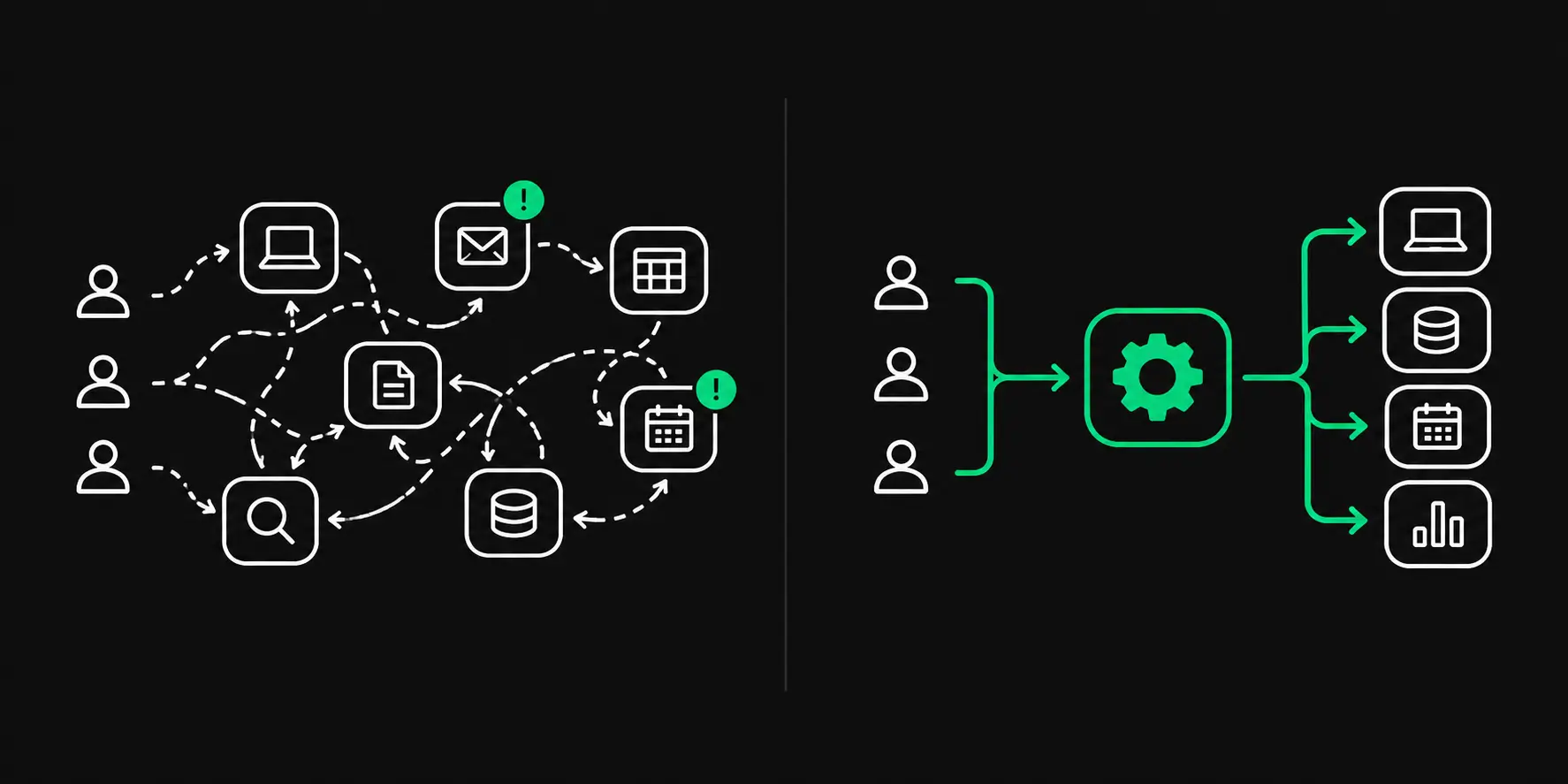
Our experience as an automation agency shows that organizational chaos is just as often caused by poorly chosen IT tools, disorganized information flow, or a lack of integration between systems. In such situations, instead of focusing on tasks that actually help scale the company, the team wastes time manually re-entering data, searching for information, tracking deadlines, and performing repetitive tasks. Worse, as the company grows, these duties usually multiply, and the chaos grows along with the business.
The impact of technology on business processes – infographic
If a company has operated this way for many years, chaos can become its daily reality. Both management and employees get used to constant ASAP, shifting priorities, and working under pressure. Over time, they stop noticing that it is possible to work differently – more smoothly, calmly, and, above all, more effectively.
However, there are several warning signs that chaos in the company is starting to genuinely limit its growth:
Everything is "ASAP" – almost every new task is given the highest priority, making it difficult to carry out previously planned activities.
Work grinds to a halt without a manager – employees do not know what they should be working on and are afraid to make independent decisions.
No one measures the results of implemented changes – the company implements new solutions but does not know if they actually bring savings or increase efficiency.
Processes are constantly changing – often without any specific justification, analysis, or communication with the team.
Everyone is busy, but the workload never decreases – even though every employee is working full-time, the list of backlogged tasks keeps growing.
More clients, but not necessarily more profit – the company is handling an increasing number of orders, yet revenue growth is not translating into improved profitability.
No one feels responsible – duties are scattered across teams, and when an error occurs, it is difficult to determine who was responsible for that stage of the process.
If you recognize several of these situations in your company, it is worth taking a closer look at how its processes actually function. Chaos does not always mean that a company is performing poorly – it often just means that its way of operating is not keeping pace with its growth.
Looking to get a handle on the chaos in your business? Get in touch with us to schedule a consultation with one of our business process specialists.
Why is this particularly dangerous for growing organizations, and how can chaos effectively block further business growth? Let's take a closer look.
Why does organizational chaos negatively impact further scaling?
One of the biggest problems caused by chaos in a company is that efficiency does not grow proportionally with the number of clients, projects, and responsibilities. On the contrary, more and more time and resources are consumed just by maintaining day-to-day operations.
Instead of focusing on tasks that actually contribute to business growth, employees spend most of their day putting out fires. The prevailing chaos means that despite their high competence, they lack the time to improve processes, implement new ideas, or take actions that could increase company revenue.
It is difficult to expect an employee who constantly has to do everything ASAP, switch between tasks, and search for information across several different systems to achieve high work efficiency. In such conditions, creative and strategic work takes a backseat, even though it is often what has the greatest impact on further scaling the company.
What does this look like in real world?
Imagine a sales department that receives more inquiries from potential clients every month. However, there is a lack of clearly defined procedures for handling them.
Every time a new client appears, the salesperson has to figure out on their own who should contact them, whether it is better to call or send a message, what commercial terms to propose, and who should approve the offer. As a result, every salesperson operates slightly differently, some decisions require consultation with a supervisor, and some inquiries simply get lost in the shuffle. Such chaos in the workflow means that handling a single client takes longer than it should, and salespeople are unable to leverage the company's full sales potential.
What happens when the number of inquiries doubles? Without changing the way of working, the company will likely have to hire more employees. The problem is that new salespeople will enter the exact same disorganized environment. Costs will rise, but efficiency will not necessarily follow.
And that is precisely one of the biggest obstacles to scaling a business – the company grows, but organizational problems and the costs of managing them grow right along with it.
What can a sales manager do in such a situation? First and foremost, they should organize the chaos in the inquiry handling process. It is worth starting by analyzing current procedures, identifying stages that are spiraling out of control, and checking where employees lose the most time. Only on this basis can a new, orderly process be implemented, responsibilities clearly defined, and repetitive tasks automated. It is equally important to measure results to know whether the changes introduced are actually improving efficiency.
How should one approach such process organization, and where should one start so as not to cause even more confusion? We will talk about this in the next part of the article.
3 steps toward better-organized processes
Below, we present 3 steps that will help you effectively organize the chaos in your company:
1. Operational audit
The first step should be to take a look at how the company functions on a daily basis. An operational audit, also known as a process audit or process workshop, helps with this. Such an analysis is often carried out by external specialists who can look at the organization from a different perspective. They talk to management, supervisors, and employees, analyze the tools used, and check how individual processes run in practice.
Importantly, they do not focus solely on official procedures, but also on what the work looks like in reality – because these two things do not always go hand in hand. Thanks to this, they can identify bottlenecks, i.e., elements of processes that slow down the work of the entire company. These could be, for example, tasks requiring manager approval every time, manual data entry between systems, or an unclear division of responsibilities.
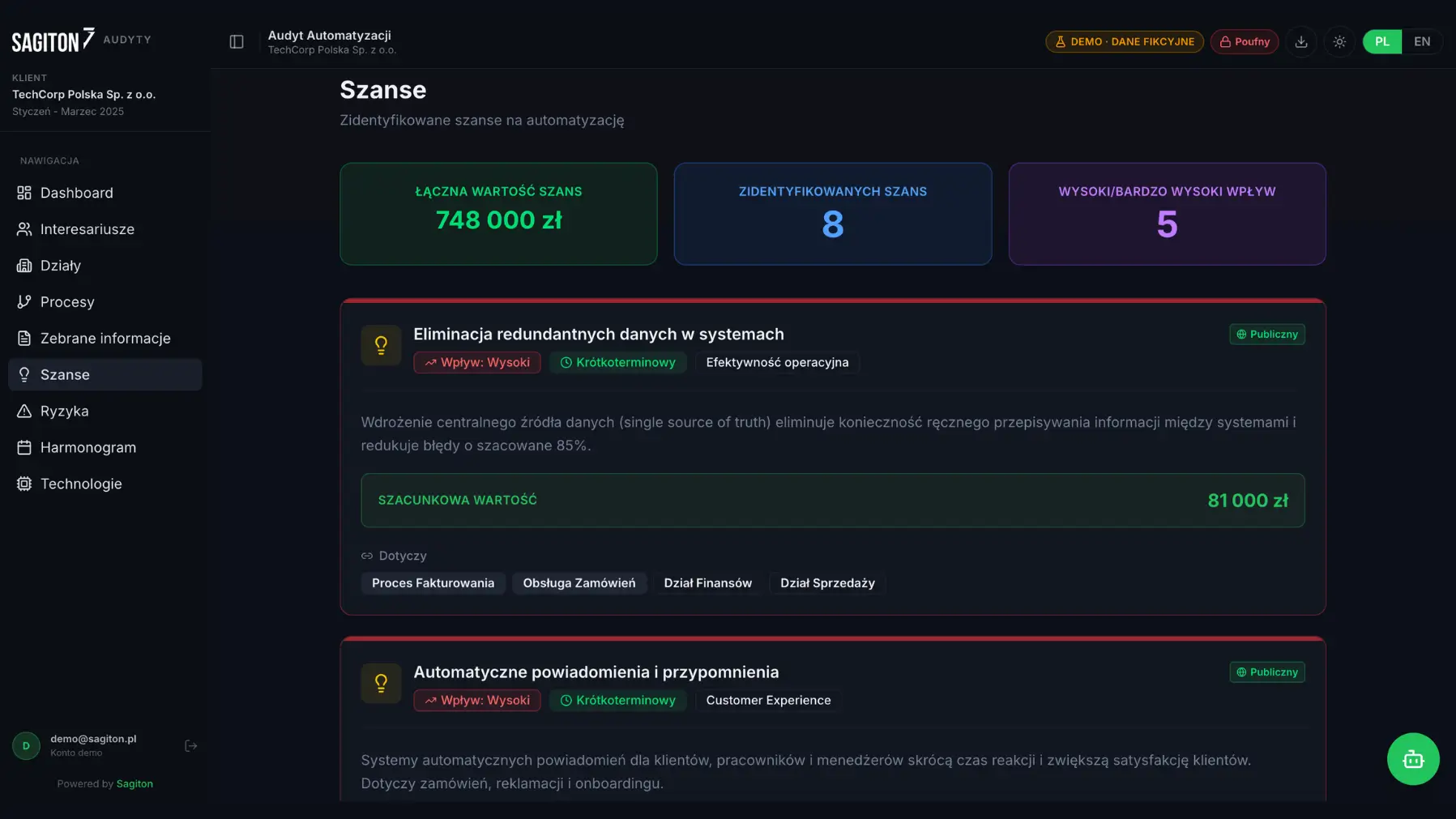
A well-conducted audit should not end with merely pointing out problems. Its results should provide concrete recommendations for improving processes, identifying automation opportunities, and selecting the right IT tools.
An example of a process analysis result showing potential savings from its optimization
It is also worth prioritizing specific changes, estimating their potential benefits, and preparing an implementation plan. You don't have to change everything at once – it is often better to start with a few improvements that will quickly relieve the burden on employees and allow you to measure initial results.
Once auditors understand the organization's structure, have spoken with stakeholders, and analyzed how individual departments function, they can move on to process mapping. A process map is a visual representation of the sequence of actions, decisions, and dependencies that make up a specific task. It allows you to see who is responsible for each stage, what events trigger a given process, what tools the team uses, and where delays or unnecessary steps occur.
Based on such a map, it is much easier to prepare clear procedures that define how to act in specific situations. Importantly, mapping often reveals problems that no one noticed before – for example, situations where several people are doing the same work or a task unnecessarily passes through multiple departments.
Usually, two types of maps are created at this stage. The first shows the company's current way of working, i.e., the procedures and processes AS-IS (current state). The second is TO-BE (target state), showing how these same processes should look after improvements are implemented. It is at this stage that you can plan the elimination of redundant steps, change the division of responsibilities, or automate repetitive tasks. The target process map becomes the basis for implementing changes based on data collected during the analysis, rather than just the intuition of managers. As a result, the company receives both documentation of the current way of working and a concrete plan for how it should function in the future.
3. Implementing changes and monitoring goals and tasks
At this stage, the company should decide how it wants to implement process standardization – on its own, using internal resources, or in cooperation with an external agency. The process of eliminating chaos is also called business process optimization and consists primarily of:
eliminating tasks that are inefficient or redundant,
restructuring procedures and streamlining current workflows,
assigning owners to individual processes and clearly defining responsibilities,
automating repetitive, tedious, and time-consuming activities.
Importantly, improving processes is just the beginning. It is equally vital to set measurable goals and regularly monitor the results. For example, in the sales department mentioned earlier, such a goal could be to reduce the time of the first contact with a potential client by 50%. To verify whether the changes are delivering the expected results, it is worth establishing specific KPIs, a method for measuring them, and identifying the people responsible for their achievement. A lack of clear rules and failure to communicate success metrics to the team can lead to even well-planned changes resulting in team frustration, causing the company to revert to old habits.
Business process automation – a way to scale without the chaos
In 2026, process optimization alone is not enough. More and more small business owners and managers in larger corporations are realizing that effectively mastering chaos requires not only improving the way of working but also implementing business process automation.
By automating tedious tasks, teams spend less time manually transferring information between systems and performing repetitive work. This frees up more space for strategic thinking and activities that genuinely drive business growth. They can make decisions more efficiently, and the company grows faster without the need to increase headcount proportionally.
Our experience shows that standardizing and automating processes has repeatedly helped our clients move from chaos to order. One such example is described below.
Case study: Standardizing and automating the employee onboarding process
We worked with a client in the IT industry who, as the company grew dynamically, began to face increasing difficulties in the onboarding process for new hires. Each new hire meant a series of time-consuming tasks for the HR department – from granting system access and loaning equipment to monitoring onboarding progress. The lack of uniform procedures and the need to involve multiple departments meant the entire process took longer and longer, creating a risk of errors.
We began the optimization project by analyzing the existing workflow and identifying areas that required change. We then introduced uniform procedures, automated repetitive tasks, and created tools that allowed the HR department to independently oversee the entire process.
By eliminating several sources of process chaos, task completion time was reduced by nearly 200 hours per month, speeding up the HR department's work by over 50%. Thanks to these changes, the company can now efficiently onboard new people without a proportional increase in workload.
Organizational chaos in the company – key takeaways
If accountability in your company is blurred, processes are dragging on, procedures are missing, and teams without managers aren't quite sure what they should be doing – it's time to act.
It is important to approach process optimization systematically, treating the company as a single organism where individual departments, procedures, and tools all influence one another. Improving one process won't always solve the problem if the root cause lies elsewhere.
It is also worth remembering that the goal of these changes is not just to improve daily organization. Well-designed and automated processes help reduce operating costs, reclaim team time, and scale operations without the need for a proportional increase in headcount. Thanks to them, company growth doesn't have to mean an ever-increasing number of tasks, delays, and problems.
That is why, if you notice similar difficulties in your organization, it is worth considering working with external specialists who can look at how it functions from a broader perspective, help identify the sources of problems, and propose concrete improvements. Because a well-functioning company isn't one where everyone is constantly busy, but one where work delivers measurable results.
Join our newsletter
Subscribe and receive additional content, checklists and business automation tips from us.
Thank you for subscribing to our newsletter!
You will soon receive a welcome message at the email address you provided.
Oops! Something went wrong, failed to send the form.
Get in touch and remove the chaos from your processes
At Sagiton Automation, we help companies automate their business processes, allowing them to eliminate chaos and information overload. Use our contact form to schedule a free online consultation with a process expert.
Optimization of business processes – a way to increase efficiency in the company
Rising operating costs and galloping efficiency pressures are causing companies to increasingly look for ways to improve their operations. Fortunately, there are methods of optimizing business processes that allow you to organize the way the organization works, reduce unnecessary activities and make better use of available resources. In this article we show you how to approach the optimization of processes in a company in a practical and scalable way.
Read more
Business automation
06.07.2026
where-to-start-automation-of-business-processes
Business Process Automation in your Company — where to start?
Business process automation is a topic that is gaining importance among entrepreneurs who want to increase work efficiency. Read the article and learn how business process automation can help your team with everyday tasks.
Read more
Business automation
24.07.2026
organizational-audit-what-is-it
What is an organizational audit? Discover 3 signs that it’s time to conduct one
Read the article to learn what an organizational audit is, when it is worth conducting, and how it can help streamline processes, reduce costs, and prepare your company for automation.
Read more
Contact us!
Select the topic you are interested in in the form and our specialist will contact you within 24 working hours.
Thank you for contacting us!
Your message has been successfully sent. We will reply as soon as possible.
Oops! Something went wrong, failed to send the form.