Manual bidding is increasingly blocking the development of construction companies. See how automatic collection of material bids and optimization of the bid preparation process can take real pressure off your team and speed up bidding decisions.
What challenges do construction contractors face with tenders?
If you run a construction company, you are well aware of this issue. To keep abreast of tenders, you need to subscribe to many databases, portals and newsletters. Every day you receive dozens of emails with information that you need to manually review, open the submitted attachments, check the scope of work and assess whether a particular tender makes sense for your company at all. In practice, this means a huge amount of time spent browsing the inbox, rewriting data to Excel, categorizing tenders, and making preliminary decisions. It is a repetitive process that does not add real value and unnecessarily burdens those responsible for bidding. In practice, they waste too much time on detailed analysis of orders that do not pass the qualification stage anyway — due to non-compliance, too high a risk, too short a deadline or other disqualifying factors. As a result, instead of focusing on promising tenders, they waste resources on offers without real opportunities, which leads to a deficit of time and a decrease in the efficiency of the entire process.
When the contractor decides to enter the tender, the stage of internal analysis of documentation and execution of objects begins. For some projects, it is the subcontractor who prepares a comprehensive offer, which includes labor as well as materials and equipment. Then part of the costing work is done on his side, and the role of the general contractor consists primarily in a thorough analysis of the offer — understanding its scope, checking the assumptions and confirming compliance with the tender requirements.
The situation is quite different when a subcontractor offers only labor, which is most often the case when the cost of materials is a significant part of the order and its financing could disrupt the subcontractor's cash flow. In this case, the full costing of materials, price and risk analysis, and the completion of a whole valuation falls on the general contractor, which means a much greater workload, greater team involvement and a decidedly more time-consuming process of preparing the offer.
The productivity of the creation of offers vs the efficiency of the entire company
In many construction companies Only 1 out of 15 tenders submitted ends with the signing of a contract. This means that only about 6% of all proposals prepared are finalized. Each offer, especially for larger projects, is tens and sometimes hundreds of hours of work — counting, analyzing documentation, checking scopes and risks.
Construction is a seasonal industry, so it is rarely profitable for contractors to hire additional people to the bidding team, since no one knows how many tenders will appear in the next month. As a result, in the most intense periods, cost estimators are unable to go through everything that is in the sales funnel.
The company then has to choose not between a “good” and a “bad” tender, but between what it has already started to evaluate and new topics. Since several dozen hours of work have already been put into a given project, it is simply not profitable to abandon it - even if there are potentially more profitable tenders. This leads to a situation where companies in the construction industry give up better opportunities just because they are already “trapped” in another bidding process.
Therefore the moment of the second qualification of the tender is crucial. Not at the stage of “does it fit the profile of the company”, but whether it is even worth devoting another week of team work to reprocess this topic. Any decision to “move on” means freezing people, time and attention. Automation of bidding in construction allows this moment to happen earlier – before the cost estimate begins to block the development of the company.
Bidding is a process that directly leads to the sale of services. Statistically, the more offers you prepare, the better your chances of winning. The question is: why do you continue to limit the development of the enterprise with manual, time-consuming preparation of offers? If at least once your company had to give up an offer just because there was no team and no time to prepare it — this is a signal that automation is necessary.
Risk of a long bidding process
Increasingly, the problem is not the preparation of the offer itself, but what happens next. The contractor spends tens of hours on analysis, valuations and cost estimates, and then the decision-making process on the investor's side drags on for months. During this time, the prices of materials and labor change, and the real margin is gradually shrinking.
The length of the proceedings is not influenced by the contractor, but it has an impact on its own cash flow. To maintain order continuity, a company cannot rely on several “frozen” tenders — they must submit more offers in the same time. The problem is that with manual bidding, the team quickly reaches the limit of efficiency.
And though implementation of automation of bidding processes does not serve to accelerate the investor's decision, but it can increase the bandwidth of the team. This implementation allows you to prepare more tenders at the same time, make decisions faster and reduce financial risks arising from long and unpredictable tendering procedures.
Deploy automation for construction contractors with us and speed up the functioning of your enterprise!
Automations for construction contractors that will reduce the time of preparation of tenders
At Sagiton, we have been cooperating with the construction industry for years, creating solutions that really improve the efficiency of the functioning of construction companies. On a daily basis, we improve processes that are repetitive, time-consuming and business-critical — especially where the company's competitiveness depends on efficiency.
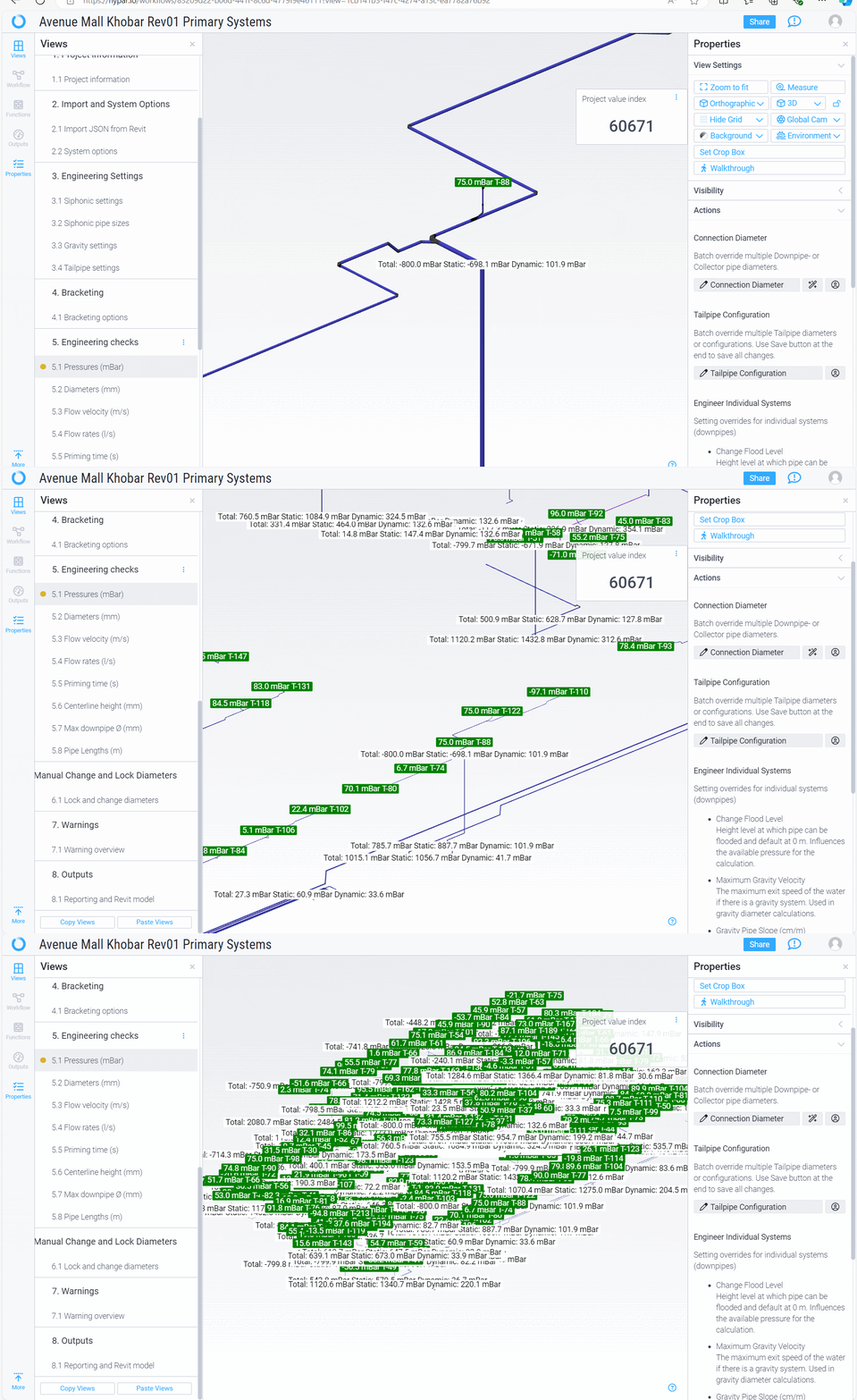
One example of such cooperation is the project Akasison AutoPlanner, which we realized together with Aliaxis to automate the process of documentation analysis and bidding. This implementation has shown us in practice how a well-designed automation has a great impact on the organization of work, the accuracy of quotations and the time of execution of offers. If you want to see what this solution looked like in practice, you can read about it here: https://www.sagiton.pl/en/services/bid-automation-in-aec#case-study
Akasison AutoPlanner for automated selection of suitable Aliaxis products
Today, we use this bid automation experience and knowledge of construction realities to help contractors prepare bids faster and more predictably. Below we show you what automations we can implement for you and how technology can relieve your team in their daily work.
Automatic collection of tenders from subcontractors
Do your employees still devote tens of hours a week to collecting, saving, recalculating and comparing offers from subcontractors? Every phone call, every message and every email is another minute snatched from time that could be spent on risk analysis, negotiation or execution management.
Implementation of automatic collection of offers from subcontractors allows you to eliminate this chaos and put the whole process in order already at the start. Importantly, this is not just about “collecting data faster”, but about creating a system that recognizes, filters and organizes the information itself.
What might an automated bid collection process look like?
Transcription and summary of phone calls by AI — phone calls are automatically transcribed (the process of converting speech (audio/video) into written text), and AI generates readable summaries containing key findings. Thanks to this, information from phone conversations is not lost, but immediately enters the system and can be further used in the bidding process.
Content from different communication channels — the system can also analyze content from SMS, WhatsApp and emails, so that all information from subcontractors, regardless of the form of contact, is collected in one place.
Multi-channel context and automated data analysis — bcause all communication goes into a single system, AI can extract key information such as scope of work, location, deadlines and link to a specific tender, even if the agreement is made only in a telephone conversation
PDF files with automatic conversation summaries — in situations where the only real form of contact with the subcontractor is a telephone, the system can send him a summary of the findings via WhatsApp or e-mail from the vending machine. After reading the PDF document, the subcontractor only needs to confirm the content with a short reaction or a simple answer. This will help us get his answer faster.
Auto prompts and reminders — if the subcontractor does not confirm the findings or submit an offer, the automation can independently send reminders on set dates, including on weekends (e.g. by SMS, email or both at the same time), so that the team does not waste time on manual questioning and monitoring responses.
As you can see, the automatic collection of offers from subcontractors makes the process, which previously took days or weeks, shorter and reduced even to several hours. This is not only a time saver, but also more control, better data quality and real competitive advantage — especially at times when the number of tenders is rapidly increasing and the team's resources are limited.
Automatic collection of material offers
Automatic collection of bids for materials can work exactly on the same principles as the automation of the collection of bids from subcontractors - the difference lies only in the data sources. The prices of materials can be obtained from emails from wholesalers, PDF offers, online price lists, supplier systems, as well as from telephone, SMS or WhatsApp communication.
With the right integrations and rules, we can immediately recognize that a message or document is about materials, identify product names, quantities, units and prices, and then assign them to a specific tender or cost item. Thanks to this team does not have to manually rewrite data or update sheets — all prices are collected in one place, compared in real time and ready for further analysis. In addition, the system can independently send reminders and reminders to material suppliers who did not respond to the request within the allotted time, so that the team does not waste time on manually monitoring the response and constant reprimand, and the process of collecting offers is carried out more efficiently and predictably.
Scoring and qualification of construction tenders
Construction companies face a large number of tenders and requests for quotations every day. Some of them look promising only at first glance, but their real potential is revealed only after a time-consuming analysis of the documentation. The problem is that such an in-depth verification also takes time - and once the team has already started counting the offer, it is no longer rational to resign after several dozen hours of work. As a result, contractors do not choose the best tenders, but those that are “already in progress”. Better opportunities pass by because people are busy with other topics. What is missing is a simple filter at the start that would allow low-bidders to quickly sift out low-bidders before they start blocking the bidding team.
Solution — Automated Tender Qualification at the Start
It is possible to implement automation for construction contractors, which takes over the preliminary qualification of tenders and RFPs. The knowledge you have in your head today — about profitability, risks, common problems or preferred investments — can be captured in the scoring algorithm and used automatically.
For example, when someone calls with a request to prepare a tender offer, information from the conversation — such as scope of work, location, approximate budget or deadlines — is automatically sent to the system. Already at this stage, it can act as a qualification filter, which will verify whether your company meets the basic conditions for participation in the tender, e.g. whether you have completed orders of similar value in the last 3 years. Such qualification helps automation to immediately eliminate those projects that formally have no chance of success. Data can also be compared to historical winning and losing bids, margins and lead times. Based on this, the project is given an initial assessment — good, medium or weak — even before the cost estimators start working. Only tenders with the appropriate scoring go to further processing. The rest are deliberately postponed or you return to them only when the market situation requires it.
Benefits of implementing new BPA (Business Process Automation) technologies
Such automation reduces decision-making time and reduces the risk of “getting stuck” in unprofitable bidding processes. The team focuses on tenders with the highest potential, and not the ones that accidentally appear first on someone's desk. This gives you more control over your bids. Most importantly, decisions about which tenders you enter are no longer intuitive and reactive, but are based on real data, experience and clearly defined criteria. This translates into increased operational efficiency and reduced bid handling costs.
The use of AI (artificial intelligence) technology to analyze documentation
One of the most time-consuming and error-prone bidding stages is the analysis of project documentation. Manually reviewing drawings and technical descriptions in large construction projects means hundreds of decisions made under time pressure. Every oversight, every miscalculated quantity is a real risk of mispricing and loss of margin.
Modern technologies based on AI allow you to transfer this process to the digital world. The systems analyze technical documentation — 2D CAD drawings, PDF files, scans or BIM models — and automatically recognize structural elements such as ceilings, walls, underpasses or foundations. On this basis, it is possible to extract quantities, create items and bills of materials without manually counting each item.
Of course, not every project can be fully automated. The documentation is sometimes incomplete, CAD files, 2D drawings (plans, sections) differ in quality. However, even partial use of AI for the analysis of documentation allows you to significantly speed up the work of the team, reduce human errors and increase the competitiveness of the construction company in the market, where the speed of response and the accuracy of the estimate are increasingly decisive for winning the tender.
What automations in construction for bid management allow the greatest cost reduction?
As you can see, the automation of processes in the construction industry can help entrepreneurs with many problems that block the development of their companies. But how does this contribute to reducing operating costs?
To assess whether automation is profitable, we always start with a simple question: how much a particular company actually spends every month on the implementation of a particular process. The key here is the working time of people — the more hours a given activity consumes, the greater the potential for savings.
For example: If a given process is handled by one person with a gross salary of €1900, and automation reduces their working time by 60%, the company recovers about €1150 per month. With the implementation of automation for €3500, the investment pays off in just over three months, and each subsequent saving directly improves the profitability of your enterprise.
Due to the different time consuming processes, there is no single “best” automation for all construction companies. The greatest cost reduction comes from solutions that include repetitive, time-consuming tasks performed daily by your supply team. The more hours your employees spend monitoring tenders, collecting bids, counting the amount of materials (e.g. concrete) or machinery, the faster automation starts to work for a company's bottom line.
Subscribe and receive additional content, checklists and business automation tips from us.
Thank you for subscribing to our newsletter!
You will soon receive a welcome message at the email address you provided.
Oops! Something went wrong, failed to send the form.
Deploy process automation in the AEC industry with us
At Sagiton, we have experience working with companies in the AEC sector, which we help automate processes. We always start cooperation by analyzing where your company is wasting the most time and money, and then we check which automations will bring you the fastest effect. If you want to see how such solutions could work in your company — book a free consultation with our specialist.
AI Transcriptions for Sales – Speed Up Sales Processes with AI
The times when salespeople had to manually record arrangements with the customer are gone irretrievably. Stacks of notes, understatements or lost emails are a thing of the past. Read our article to learn how automated call transcription can speed up your sales processes and help you turn your data into a competitive advantage.
Read more
Business automation
07.07.2026
company-savings-with-automation
How much can you save in your business in 2026 with process automation?
All the companies around you, including your competition, have already started to automate, and you still don't know if it pays off at all? Read our article and find out how much you can really save by automating your business — an article written based on real data from our projects.
Read more
Sales
06.07.2026
bid-management-automation-speed-up-your-offers
Bid Management Automation — how to speed up Offer Creation with AI
The process of creating offers is an integral part of acquiring clients in many industries, especially in the B2B sector. Read our article and learn how to speed up the sales process and respond to more inquiries at the same time, thanks to the automation of the creation of trade offers.
Read more
Contact us!
Select the topic you are interested in in the form and our specialist will contact you within 24 working hours.
Thank you for contacting us!
Your message has been successfully sent. We will reply as soon as possible.
Oops! Something went wrong, failed to send the form.


%20(1).jpg)