The first days of a new person's work are a time when it is easy to organizational chaos, delays and lack of consistent information appear. Properly implemented onboarding automation, however, allows you to organize the process of employee deployment, shorten the adaptation time and provide real support to HR teams and managers. Read the article below and find out what automation of the onboarding process is worth implementing!
Automation of onboarding — what improvements in the employee onboarding process can you implement?
As you probably know, the employee deployment process begins long before the first day of work and involves many repetitive administrative tasks. However, it is worth remembering that employee onboarding can look completely different depending on the organization.
In some companies, formalities play a key role — the number of documents to sign, staffing processes and compliance with procedures make HR tasks the most time-consuming and thus require the most automation. In other organizations, onboarding can mainly focus on intensive training, familiarization with the new job position and support in adapting to the environment. In these cases, the biggest challenge is the management of educational materials, training schedules and time allocated for the initial development of new employees.
Automation of the employee onboarding process allows you to adapt solutions to the real needs of the organization and optimize the tasks performed manually - regardless of whether the priority is HR processes or competence development. In this article however, we focus on the elements that occur in almost every onboarding process and have the greatest impact on the effectiveness of the implementation of new employees.
Below we describe the key areas where automated onboarding brings the greatest value.
Onboarding management panels
Onboarding management panels are ready-made applications or dedicated systems implemented in no-code or low-code technology, which allow to adapt interfaces to the real needs of a given company. Such solutions often include dashboards, statistics, and operational views, so that the employee onboarding process is managed in one central place. Importantly, the implementation of automated onboarding in this form does not require building systems from scratch or involving development teams.
Onboarding panels may include, among others:
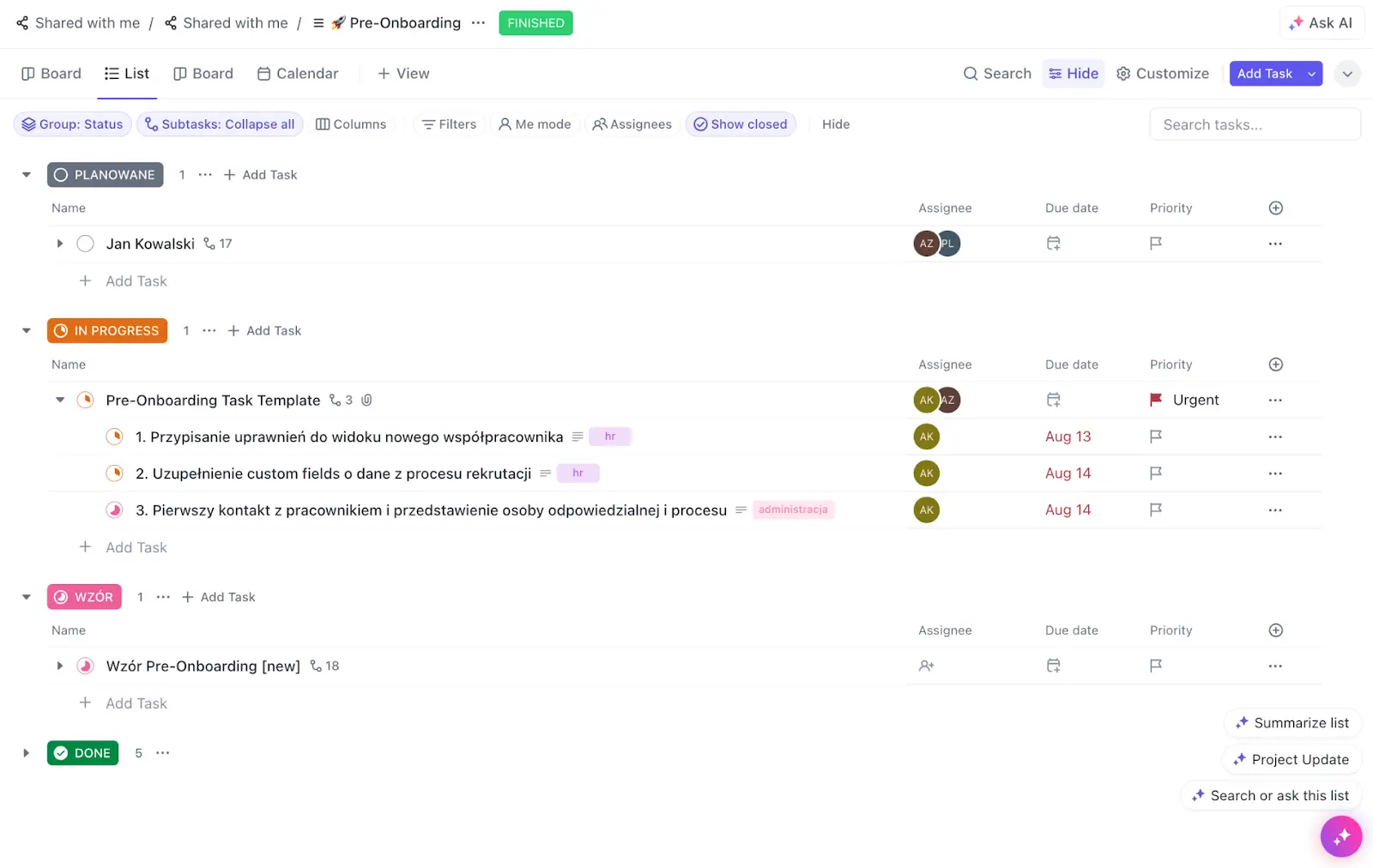
views for managing tasks in the onboarding process of a given employee, divided into stages and responsible persons,
dashboards that visualize key indicators such as employee turnover, employee deployment time or the progress of new employees,
lists of active onboarding processes with information on what stage of implementation each person is at,
preview of the statuses of documents, access to systems and implementation of trainings.
An example of an onboarding management panel created in the Clickup tool
The most basic onboarding automation to start with is just such a process management panel. With more new team members, monitoring the onboarding process quickly becomes a challenge. When the onboarding process starts in parallel for several people and each of them is at a different stage of training, the lack of a single source of information leads to delays and misunderstandings. Unfortunately, in many companies, data on what stages of the process have already been completed is still stored in Excel sheets or manually distributed documents. This way of working is troublesome and prone to errors — someone may forget to complete the status of a task, skip an important step or not add important information. As a result, communication chaos occurs, which from the perspective of a new employee in a new workplace strongly influences the first impression and decreases the satisfaction of new employees.
However, the appropriate implementation of the automation of the onboarding process allows central management of information on the progress of new employees in real time. Thanks to this, HR and managers have full visibility of what stage of process each person is at, which translates into faster decisions, better support for new employees and a consistent, professional course of the implementation process.
Consistent checklists and schedules
One of the most important views in onboarding management dashboards is onboarding checklists and schedules. It is they that make it possible to unify the process of onboarding employees throughout the company and ensure that the deployment of a new person follows clearly defined rules, regardless of the team or the manager.
In many organizations, employee onboarding looks different depending on the person responsible for it. This leads to inconsistencies in the transmission of information, skipping important steps and lengthening the adaptation time of new employees. The lack of a common standard also makes it difficult to assess the effectiveness of the onboarding process or compare the experience of new employees.
Automated checklists and schedules organize the onboarding process, breaking it down into clearly defined onboarding stages. Each new person receives the same important information, assigned tasks or meeting dates for the first days of work. This way of working is a real facilitation of the onboarding process, which increases transparency, improves the experience of new employees and allows HR to maintain control over the entire process.
Is employee onboarding at your company chaotic? Contact us and implement the automation of HR processes!
The preparation and circulation of onboarding documents is one of the most time-consuming and critical elements of the process of implementing a new employee. Contracts, personnel forms, approvals, medical examinations or OSH training often require the involvement of several departments at the same time. Manually filling in data, sending files by mail and checking statuses manually significantly increases the risk of errors, delays and misunderstandings.
A particular problem is the communication between the human resources or administration department, which is responsible for onboarding documents, and the hiring manager — that is, the manager or team leader to whom the new employee joins. In practice, the hiring manager often does not have clear information at what stage of onboarding a person is:
whether all contracts have already been signed,
whether the employee has undergone the required medical examinations,
whether it is possible to start job training or plan the first tasks.
Lack of this knowledge causes downtime — the manager does not know whether he can already actively start the onboarding process or whether he or she still has to wait for the completion of the formalities. This, in turn, lengthens the process of employee deployment and negatively affects their first experiences in the company.
Automation of HR processes allows you to effectively bypass this communication problem:
Onboarding documents can be generated automatically based on the data of the new employee and made available online in a single system.
The employee independently completes the required information - they can also sign documents electronically, thanks to which the statuses will be updated in real time.
If the employee signs the documents in paper form, the person in charge of the administration can mark with one click in the onboarding panel when individual contracts or forms have been signed.
This automation of the onboarding process makes the hiring manager gain Immediate access to up-to-date information and knows exactly at what stage of onboarding the new employee is. This is a real increase in the availability of information, which eliminates guesswork and the need for constant e-mail or telephone queries.
In addition, the system can send automated reminders - e-mail or SMS - if the employee did not sign the document by the specified date or if someone on the side of the company forgets to complete his task.
Access management
A common problem in the first days of work is also the lack of access to the necessary digital tools for the employee. The process of assigning accounts and entitlements usually requires collaboration with IT, which increases employee onboarding time and creates unnecessary dependencies between teams.
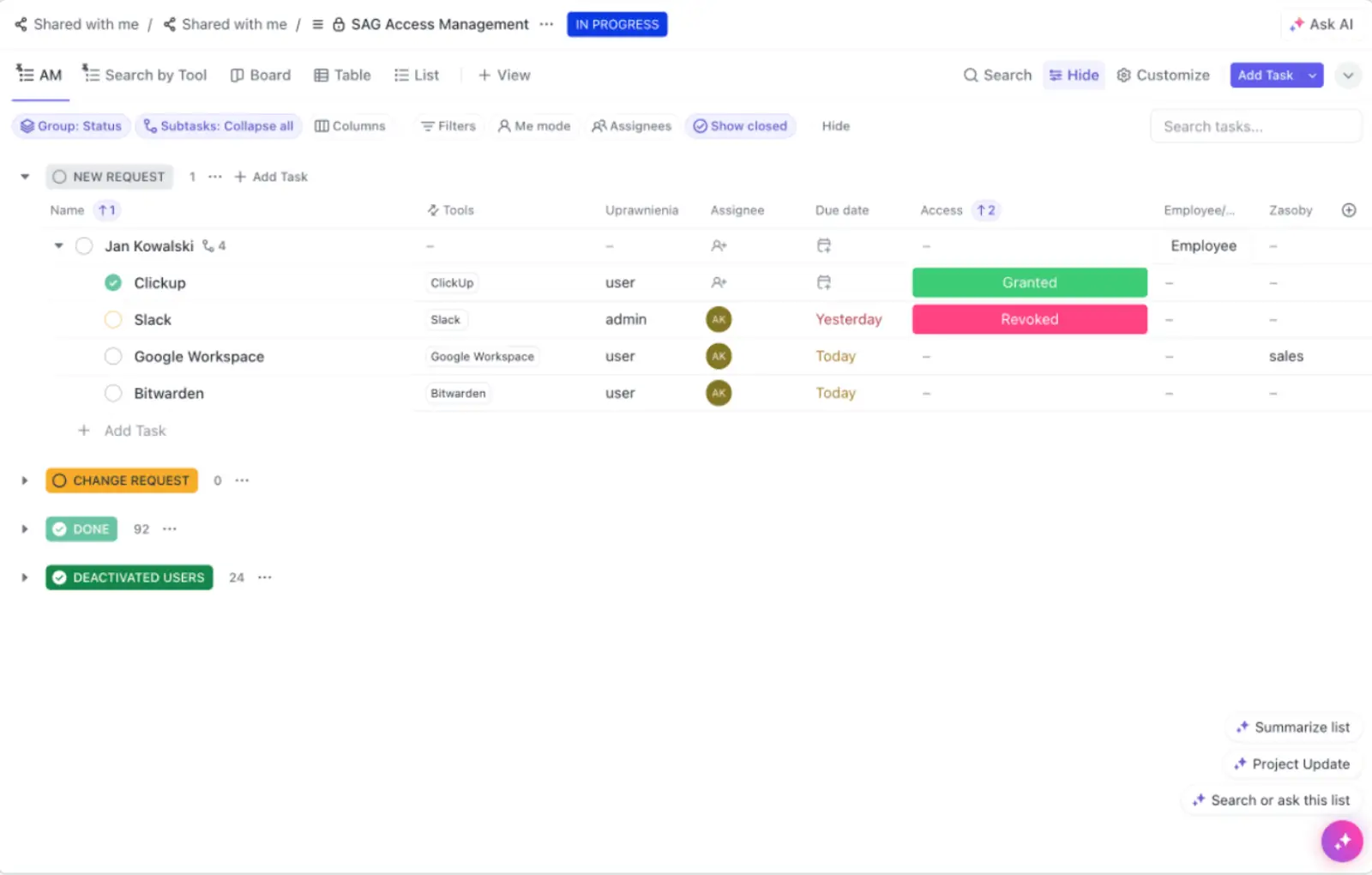
Automation of onboarding makes it possible to simplify this stage. How can such an improvement work? The HR department determines the needs of the employee, and the process automation system sends a notification to the IT department with a clearly defined deadline for creating accounts and granting access. If the task is not completed by the deadline, the system sends further automated reminders, minimizing the risk of delays. At the same time, the hiring manager has an overview of the list of granted and pending accesses, so he knows exactly at what stage of onboarding the new employee is and when they can safely start the proper onboarding process.
List of tools used in the process of granting access
Automatic inventory of equipment
The onboarding of new employees involves the issuance and registration of IT equipment, which is difficult to control with the rapid pace of personnel changes. As we wrote in previous paragraphs, in many organizations data about laptops, phones or accessories is still stored in Excel sheets, often in several different versions. This leads to situations where the information does not match, there is a lack of up-to-date data on who is using the equipment, and the company is exposed to the loss of important information or errors in the documentation.
The implementation of automation of HR processes allows us to combine documents and inventory of equipment into one coherent mechanism based on a central database. Rental agreements and pick-up protocols can be generated automatically and all information saved in one place (e.g. in a data management tool such as Airtable). Thanks to this, documents and information about who currently owns what equipment can be easily filtered, searched, divided into periods or integrated with other systems. This approach significantly simplifies document management in the onboarding process and increases control over IT resources from the first day of work of a new employee.
Collect feedback on new employees after the first 30 days of work
Without a clear structure, the collection of feedback on employees in the first days of work is often carried out irregularly and in various forms. It is then difficult to reliably assess the progress of new employees and the actual effectiveness of the onboarding process. This stage usually occurs at the end of the onboarding — e.g. after 14 or 30 days of work — and that's when it provides the most valuable information about the employee's fit into the team and role.
The lack of a structured feedback collection process carries a real risk of hiring the wrong people, which the organization may simply not know about. Without a clear framework and tools, employees and managers are often afraid to make their comments about the cooperation or quality of work of a new person, which leads to the silencing of problems and postponing difficult decisions in time.
Fortunately, automatic onboarding can effectively solve this problem. Automated surveys sent at specific points in the employee onboarding process — for example, after 14 and 30 days — organize and formalize the collection of feedback. The data goes to a single place where it can be analyzed and compared, which facilitates quick response, early support of new employees and continuous improvement of the entire onboarding process.
Automatic onboarding and the relationship with the newly hired employee
A common concern of companies is the belief that automatic onboarding can negatively affect the building of relationships with the employee. Because the first 30 days of work is a key moment to build trust, a sense of security and a good relationship with the team and the hiring manager. In practice, however, properly implemented automation of the onboarding process not only does not pose a threat to these relationships, but even strengthens them.
Modern onboarding systems are safe, orderly and eliminate organizational chaos, so that the new employee perceives the company as professional and well-prepared from the very beginning. Instead of the frustration of missing documents, access or unclear communication, there is a sense of control and clarity of the process. Moreover, by removing tedious, repetitive administrative tasks from HR, IT and hiring managers, automation really increases the space for the human element. Managers and new colleagues can devote more time to conversations, substantive support, implementation into the organizational culture and daily collaboration. As a result, relationships do not disappear — on the contrary, they become more qualitative, because they are built on attention and commitment, and not on the fight against formalities.
Do you want to improve the onboarding process of employees in your company? Book a consultation with our specialist — we will help you automate HR processes!
Subscribe and receive additional content, checklists and business automation tips from us.
Thank you for subscribing to our newsletter!
You will soon receive a welcome message at the email address you provided.
Oops! Something went wrong, failed to send the form.
We also implement automation of recruitment and other HR processes
At Sagiton, we also implement other automation of HR processes, including improvements related to recruitment or employee surveys. Find out more about our services!
How can Implementing Automation of Recruitment Processes Support your HR Department?
Despite overtime in the HR department, the process of recruiting employees in your company is still prolonged, which causes frustration for both recruiters and applicants? Read our article and learn how automation of recruitment processes can save your HR team time while providing a better candidate experience.
Read more
Business automation
07.07.2026
6-ways-to-use-ai-in-business
6 Ways to Use Artificial Intelligence in Your Business
Find out in which areas of business the use of artificial intelligence is most cost-effective and what the biggest benefits of AI are for businesses.
Read more
Business automation
06.07.2026
business-process-automation-guide
Business process automation - improve your company's operations!
Automation of business processes seems to be the so-called “must-have” in any modern organization. If in your company you are still manually aggregating data, calculating salaries or issuing invoices — this article is for you! Find out how much automation costs, how to implement it, and what are the advantages of improving business processes.
Read more
Contact us!
Select the topic you are interested in in the form and our specialist will contact you within 24 working hours.
Thank you for contacting us!
Your message has been successfully sent. We will reply as soon as possible.
Oops! Something went wrong, failed to send the form.



.webp)

.webp)